
Hospital floors are one of the most critical surfaces in any healthcare setting. They must be spotlessly clean, free from harmful pathogens, and safe for patients, staff, and visitors at all times. A single lapse in floor hygiene can lead to hospital-acquired infections (HAIs) , a serious concern across healthcare facilities in the UAE and worldwide.
Unlike regular commercial cleaning, hospital-grade floor cleaning requires specialized disinfectants that kill bacteria, viruses, fungi, and spores. In this guide, we break down exactly which floor cleaners hospitals use, how they work, and why choosing the right product matters.
Which floor cleaners are used in hospitals?
Hospitals primarily use quaternary ammonium compounds (quats), sodium hypochlorite (bleach-based cleaners), accelerated hydrogen peroxide, and phenolic disinfectants for floor cleaning. The choice of cleaner depends on the ward type, infection risk level, and the floor surface being cleaned. Enzymatic pre-cleaners are used before disinfection in areas exposed to biological fluids.
Why Hospital Floor Cleaning Is Different from Commercial Cleaning?
Domestic and standard commercial floor cleaners are formulated to remove dirt and leave surfaces looking clean — but they are not designed to kill clinical-level pathogens. Hospital-grade floor cleaners must:
- Eliminate bacteria including MRSA, VRE, and Clostridioides difficile (C. diff)
- Be virucidal against enveloped and non-enveloped viruses (including Hepatitis B, C, and coronavirus)
- Work within a defined dwell time — the period the product must remain wet on the surface to achieve kill efficacy
- Be compatible with hospital floor types including vinyl composition tile (VCT), epoxy, linoleum, and ceramic
- Meet international standards such as EN 14476, EPA registration, or equivalent certifications recognised in the UAE
Using a standard supermarket floor cleaner in a hospital ward does not just underperform — it creates a false sense of security while dangerous pathogens survive on the surface.
Types of Floor Cleaners Used in Hospitals
1. Quaternary Ammonium Compounds (Quats)
Quats are the most widely used hospital-grade disinfectants for routine floor cleaning in general wards, corridors, and outpatient areas. They work by disrupting the cell membranes of bacteria and inactivating enveloped viruses.
Key advantages:
- Broad-spectrum efficacy against bacteria, fungi, and enveloped viruses
- Low toxicity and minimal odour — suitable for occupied patient areas
- Fast-acting with relatively short dwell times (typically 5–10 minutes)
- Compatible with most hospital floor surfaces
Limitations: Standard quats do not kill bacterial spores (including C. diff) and may be less effective against non-enveloped viruses. They are not recommended for isolation rooms.
Typical UAE use: Daily cleaning of general wards, nursing stations, reception areas, and corridors.
2. Sodium Hypochlorite (Chlorine-Based Disinfectants)
Sodium hypochlorite, the active ingredient in bleach-based hospital cleaners, is the gold standard for high-risk areas and outbreak response. It is the only common hospital floor disinfectant proven effective against C. difficile spores — which are resistant to most other cleaning agents.
Key advantages:
- Kills bacterial spores, fungi, bacteria, and a wide range of viruses
- Highly effective for biohazard decontamination (blood, bodily fluids)
- Recommended by CDC and WHO for C. diff-affected areas
- Cost-effective and widely available
Limitations: Requires careful dilution (typically 1,000–10,000 ppm depending on risk level). Can damage floor finishes, metal surfaces, and certain tiles if used at incorrect concentrations. Strong fumes require adequate ventilation.
Typical UAE use: Isolation rooms, patient bathrooms, biohazard spill response, terminal cleaning of rooms after infectious patients.
3. Accelerated Hydrogen Peroxide (AHP)
Accelerated hydrogen peroxide solutions use a lower concentration of H₂O₂ combined with surfactants to achieve hospital-grade disinfection faster than standard hydrogen peroxide formulas. After use, AHP breaks down into water and oxygen, leaving no toxic residue.
Key advantages:
- Effective against bacteria, spores, viruses, and fungi
- Environmentally friendly — no hazardous residue
- Safe on sensitive floor surfaces including sealed wood and vinyl
- Increasingly popular with UAE hospitals pursuing sustainability and green cleaning certifications
Limitations: Higher cost per litre than quats or bleach. Requires proper storage away from light and heat.
Typical UAE use: All hospital areas where eco-conscious disinfection is a priority; increasingly used in operating theatres and NICU wards.
4. Phenolic Disinfectants
Phenolic compounds offer broad-spectrum germicidal activity, including effectiveness against mycobacteria (tuberculosis organisms), which makes them particularly valuable in high-risk clinical environments.
Key advantages:
- Effective against mycobacteria, fungi, bacteria, and many viruses
- Persistent residual activity on surfaces
- Useful in areas with high TB risk or immunocompromised patient populations
Limitations: Higher toxicity profile than quats or AHP — requires PPE during application. Not recommended for food preparation areas. Some phenolic products are being phased out in favour of greener alternatives.
Typical UAE use: ICU floors, isolation wards, operating theatres, and areas treating immunocompromised patients.
5. Enzymatic Pre-Cleaners
Enzymatic cleaners work differently from disinfectants — they contain biological enzymes that break down organic matter (blood, urine, faeces, mucus) at a molecular level before disinfection takes place.
Key advantages:
- Remove organic bioburden that can shield pathogens from disinfectants
- Essential step before disinfection in high-soil areas
- Biodegradable and low toxicity
Important note: Enzymatic cleaners are not disinfectants. They must always be followed by an appropriate hospital-grade disinfectant. Using them alone does not achieve infection control compliance.
Typical UAE use: Pre-cleaning step in operating theatres, emergency departments, and anywhere body fluids are present.
Hospital Cleaning Zones: Matching the Cleaner to the Risk Level
One of the most important principles in healthcare cleaning is zone-based risk stratification. Not every area of a hospital carries the same infection risk — and the floor cleaner used must match the risk level of the zone.
| Risk Zone | Examples | Recommended Floor Cleaner |
|---|---|---|
| Critical / High-Risk | ICU, Operating Theatre, NICU, Isolation Rooms | Sodium hypochlorite or AHP with sporicidal activity |
| Moderate-Risk | General Wards, Patient Rooms, Procedure Rooms | Quaternary ammonium compounds or AHP |
| Low-Risk | Corridors, Waiting Areas, Admin Offices | Neutral pH detergent + quat disinfectant |
| Biohazard Response | Any area with blood/body fluid spillage | Sodium hypochlorite (1,000–10,000 ppm per spill protocol) |
| Kitchen/Catering | Hospital kitchen floors | Alkaline degreaser + food-safe sanitiser |
The Color-Coded Mop System: Essential for UAE Hospitals
Using the right floor cleaner is only half the equation. Cross-contamination between zones is a leading cause of HAIs — and the color-coded mop system is the standard protocol for preventing it.
The internationally recognised color-coding system (recommended by NHS, CDC, and JCI-accredited facilities) is:
- 🔴 Red — High-risk washrooms, patient toilets, biohazard areas
- 🔵 Blue — General areas, corridors, waiting rooms
- 🟢 Green — Food preparation and catering zones
- 🟡 Yellow — Isolation rooms and infectious patient areas
Each mop, bucket, and cloth is assigned a colour zone and must never be used outside its designated area. In UAE hospitals seeking JCI accreditation, this colour-coded system is inspected during compliance audits.
Additionally, best practice requires one mop head per room — particularly in patient rooms and isolation areas. Reusable mop heads must be laundered between uses at temperatures above 60°C; disposable microfibre pads are increasingly preferred for high-risk zones.
Step-by-Step Hospital Floor Cleaning Process
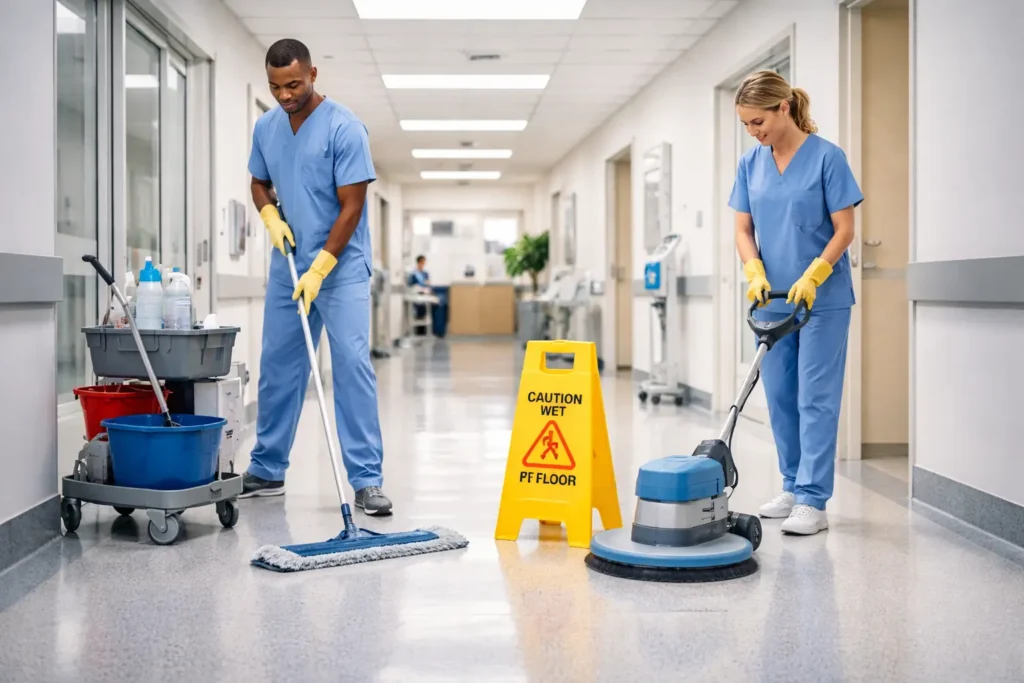
Professional hospital cleaning follows a strict protocol to prevent cross-contamination and ensure infection control compliance, which is why partnering with reliable floor cleaning suppliers in UAE is essential for maintaining high hygiene standards.
Step 1: Clear and Isolate the Area
Place wet floor signs and remove any obstacles. In patient rooms, inform the patient before beginning.
Step 2: Dry Removal of Surface Debris
Use a microfibre dust mop (not a broom — brooms disturb and spread airborne particles) to remove loose dust, debris, and particles. Always move from clean areas to dirtier areas.
Step 3: Apply Enzymatic Pre-Cleaner (Where Required)
In areas with visible organic soil, apply an enzymatic cleaner, allow contact time, then remove. This step is mandatory in operating theatres, emergency departments, and any area with biological spillage.
Step 4: Apply Hospital-Grade Disinfectant Floor Cleaner
Select the appropriate disinfectant for the zone (see Zone Chart above). Apply with a colour-coded mop or auto-scrubber. Ensure correct dilution ratio — too dilute reduces efficacy, too concentrated can damage floors or irritate occupants.
Step 5: Observe Dwell Time
This step is frequently skipped — and it is the most consequential mistake in hospital cleaning. The disinfectant must remain visibly wet on the surface for the full contact time specified on the product label (typically 5–10 minutes for quats, 1–5 minutes for AHP, 10 minutes for hypochlorite).
Step 6: Scrub and Agitate
Use a colour-coded mop or auto-scrubber to work the solution into grout lines, floor edges, and corners. Automated floor scrubbers are significantly more effective than manual mopping and are the recommended standard in high-traffic UAE hospitals.
Step 7: Rinse If Required
Some disinfectants — particularly bleach-based products — require a rinse pass to prevent floor surface damage and chemical residue build-up. Follow the product label guidance.
Step 8: Allow to Dry Completely
Floors must be fully dry before foot traffic resumes. Wet floors are both a patient safety hazard (slip risk) and an infection risk (moisture supports microbial regrowth). Use fans or allow adequate drying time.
Step 9: Document the Cleaning Activity
All cleaning activities in UAE healthcare facilities should be logged. Many hospitals use digital cleaning logs or ATP bioluminescence testing (which detects biological residue in 15 seconds) to verify cleaning effectiveness and satisfy audit requirements from DHA, DoH, or JCI inspectors.
Benefits of Using the Right Hospital Floor Cleaner
- Reduces Hospital-Acquired Infections (HAIs) significantly
- Meets UAE Ministry of Health and HAAD/DOH regulatory standards
- Protects patients, staff, and visitors from pathogen exposure
- Extends the life of flooring materials like vinyl, epoxy, and tiles
- Supports Joint Commission International (JCI) accreditation requirements
- Improves overall hospital hygiene audit scores
- Enhances patient confidence and satisfaction in the facility
Floor Cleaning Equipment Used in UAE Hospitals
Choosing the right equipment amplifies the efficacy of even the best floor cleaner.
Auto-Scrubber Dryers are the standard for high-traffic hospital areas. They apply cleaning solution, scrub, and recover dirty water in a single pass — significantly more effective than traditional mopping. They reduce water consumption, lower chemical waste, and produce consistent results. Walk-behind models suit wards and corridors; ride-on models are used in large facilities.
Microfibre Mop Systems have largely replaced cotton string mops in UAE hospitals. Studies show microfibre pads remove up to 93.6% of surface bacteria — compared to 79.8% for conventional cotton mops. They require less chemical product, dry faster (reducing slip risk), and can be laundered hundreds of times.
Steam Cleaning Units use high-temperature steam (above 82°C/180°F) to sanitise without excessive chemical use. They are particularly effective in operating rooms and other critical areas but require careful use around sealed electronic equipment.
UV Disinfection Systems are increasingly used as a supplementary “no-touch” disinfection method. UV-C light kills pathogens on exposed surfaces in 15–20 minutes and is used after manual cleaning in isolation rooms and operating theatres.
HEPA-Filtered Vacuum Cleaners are used for carpeted areas and fabric surfaces in hospital settings where vacuuming is required. Standard vacuums release captured particulates back into the air; HEPA filtration retains them.
Cost & Pricing Factors for Hospital Floor Cleaning Products in UAE
The cost of hospital-grade floor cleaning solutions in the UAE varies based on several factors:
- Type of disinfectant: Hydrogen peroxide and phenolic products cost more than basic quats
- Concentration level: Ready-to-use (RTU) solutions cost more per litre than concentrated formulas
- Volume purchased: Bulk purchasing for large hospitals reduces per-unit costs significantly
- Brand and certification: EPA, EN 14476, or ISO certified products carry a premium
- Frequency of use: High-traffic wards require more frequent applications
- Supplier location: Local UAE suppliers offer faster delivery and better pricing than imports
Conclusion
Choosing the right floor cleaner for your hospital or healthcare facility is not just about cleanliness, it is about patient safety, infection control compliance, and regulatory excellence. Whether you need quaternary ammonium compounds for daily ward cleaning, hydrogen peroxide solutions for eco-conscious disinfection, or chlorine-based products for biohazard areas, the right product must match the specific risk level of each zone.
Ready to upgrade your hospital hygiene standards? Kemtech Hygiene Concepts supplies premium, hospital-grade floor cleaning solutions across the UAE. Contact us today for a free consultation, product samples, and bulk pricing trusted by healthcare facilities from Dubai to Abu Dhabi.
Frequently Asked Questions (FAQs)
What is the best floor cleaner for hospitals?
The best hospital floor cleaner depends on the ward type. Quaternary ammonium compounds work well for general areas, while hydrogen peroxide or chlorine-based solutions are better for high-risk and isolation zones.
Are hospital floor cleaners safe for patients?
Yes, when used correctly. Hospital-grade disinfectants are tested for efficacy and safety. Always ensure proper ventilation and allow floors to dry fully before patients or visitors enter the area.
How often should hospital floors be cleaned?
High-risk hospital areas should be cleaned and disinfected at least twice daily. Corridors, waiting areas, and general wards typically require daily or shift-based cleaning with documented records.
Do UAE hospitals use eco-friendly floor cleaners?
Yes, many UAE hospitals are adopting accelerated hydrogen peroxide (AHP) and other green-certified floor disinfectants as part of their sustainability and infection control strategies.