

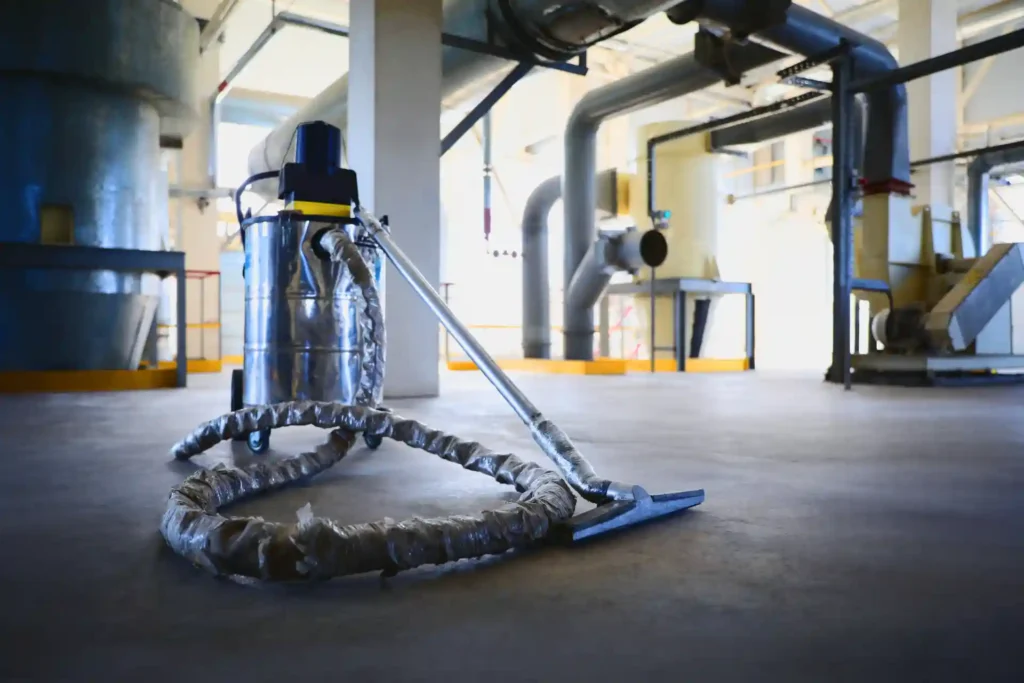
How to Choose an Industrial Vacuum Cleaner?
Industrial vacuum selection isn’t like buying a home appliance. The wrong machine can damage your facility, void safety certifications, or create compliance issues under UAE occupational health regulations.
This guide covers the technical factors that matter: suction specs, filtration grades, and motor durability in Dubai’s climate. Whether you manage a construction site in Al Quoz or a food production line in JAFZA, you’ll know what to look for and what to avoid.
Quick Answer
- Match the vacuum type to your waste: dry debris, wet spills, and hazardous dust require different machines.
- Check suction power (CFM/Pa), filtration grade (HEPA for fine dust), and tank capacity.
- For Dubai’s industrial environments—construction sites, warehouses, food facilities prioritize IP-rated, heat-tolerant machines.
- Factor in total cost of ownership (filters, bags, maintenance), not just the sticker price.
- Kemtech supplies industrial vacuum cleaners across the UAE with options for a wide range of industries.
What Is an Industrial Vacuum Cleaner?
An industrial vacuum cleaner is a heavy-duty suction machine built for commercial and industrial environments where household vacuums would fail. These machines handle large volumes of debris, hazardous dust, liquids, and abrasive materials continuously, across long shifts, without breaking down.
Unlike consumer models built for 30-minute home use, industrial vacuums are engineered for 8–24 hour continuous operation, with motors ranging from 1,000W to over 10,000W, filtration systems that trap particles as small as 0.3 microns, and tanks from 20L to over 200L.
Key Factors to Consider Before Buy An Industrial Vacuum Cleaner
1. Suction Power and Airflow
Suction power is measured two ways: airflow (CFM cubic feet per minute) and static pressure (Pa or mbar). Both tell you different things:
- CFM (Airflow): How much air moves through the machine. High CFM matters for picking up light dust over large areas.
- Static Pressure (Pa): How hard the machine pulls. Essential for dense debris, long hose runs, or fine particles that cling to surfaces.
For most Dubai industrial applications, aim for a minimum of 230 CFM with at least 20,000 Pa of suction. Construction environments typically need more.
2. Tank Capacity
Tank size determines how often your team stops to empty the machine. Undersized tanks interrupt workflows; oversized tanks become hard to maneuver safely.
Tank Size:
|
3. Filtration System
Filtration is where most buyers go wrong. The core rule: match the filter grade to the hazard. The wrong filter doesn’t just fail to protect workers it can damage the machine itself. Section 4 covers this in detail.
4. Motor Type and Duty Cycle
Industrial vacuums use single-stage or multi-stage bypass motors, or peripheral discharge motors. Multi-stage motors deliver more consistent suction and handle heat better critical in Dubai, where ambient temperatures regularly exceed 45°C in summer.
Duty cycle tells you how long the machine can run continuously. Full-shift operations need 100% duty-cycle rated motors. Anything less risks motor burnout.
5. Mobility and Ergonomics
Consider how the vacuum will actually move around your site. Large drum vacuums need heavy-duty castors rated for uneven surfaces. Backpack models suit confined spaces. Central vacuum systems work well for fixed production lines.
Comparison Between Different Industrial Vacuum Types
Not all industrial vacuums are the same. Here’s how the main categories compare for common Dubai use cases:
| Type | Best For | Capacity | Special Feature | Typical Use in Dubai |
| Drum / Tank Vacuum | General industrial debris | 60–200L | Wet & dry capable | Warehouses, workshops |
| Backpack Vacuum | Confined spaces, stairs | 10–16L | Hands-free mobility | Hotels, retail, aircraft MRO |
| HEPA Industrial Vacuum | Hazardous dust, asbestos | 20–80L | H13/H14 HEPA filter | Construction, demolition, labs |
| Pneumatic (Air-Powered) | Explosive/flammable environments | 20–100L | No electric motor | Petrochemical, oil & gas |
| Central Vacuum System | Fixed production lines | Unlimited | Piped network | Food processing, pharma |
| Explosion-Proof Vacuum | Classified hazardous zones | 30–100L | ATEX certified | Chemical plants, JAFZA facilities |
Kemtech Hygiene Concepts offers a comprehensive range of industrial vacuum cleaners Dubai suited for construction, food processing, petrochemical, hospitality, and healthcare environments across the UAE.
Filtration Grades Explained: What the Letters Actually Mean
Filtration standards follow the EN 1822 classification. Most buyers assume any filter labeled “HEPA” is equivalent. It’s not.
| Filter Class | Efficiency | Particle Size | Typical Application |
| M-Class (Medium) | 99.9% @ 0.3 microns | Coarse to fine dust | Woodworking, general construction |
| H-Class (High) | 99.995% @ 0.3 microns | Fine hazardous dust | Asbestos, silica, lead dust removal |
| HEPA H13 | 99.95% @ most penetrating | Ultra-fine particles | Pharma, cleanrooms, hospitals |
| HEPA H14 | 99.995% @ most penetrating | Nano-scale particles | Labs, sterile environments |
| ULPA U15 | 99.9995% | Sub-micron particles | Semiconductor manufacturing |
Note: In Dubai’s construction sector, silica dust from concrete and stone cutting is classified as a Group 1 carcinogen by the International Agency for Research on Cancer (IARC). An H-Class vacuum isn’t optional it’s a legal and ethical requirement.
Dubai-Specific Considerations: What Changes in This Market
Several factors consistently catch out buyers who use European or US buying guides without adjusting for local conditions.
1. Heat and Dust Tolerance
Dubai’s summer temperatures push ambient air above 45°C. Motors rated for 40°C ambient will underperform or fail. Look for machines with thermal overload protection and IP54 or higher dust/moisture ratings.
2. Construction Demand
Dubai’s ongoing mega-projects put construction vacuums in constant use. Machines with sealed bearing motors and polyurethane-lined tanks consistently outlast competitors by 2–3x on active construction sites.
3. JAFZA and Free Zone Compliance
Certain Dubai industrial zones have specific safety requirements. If your facility handles flammable or explosive materials, ATEX-certified vacuums are mandatory under UAE Fire and Life Safety Code. Non-compliant equipment is among the top five causes of safety violations in UAE industrial zones (UAE OSHAD reports, 2023).
4. Multilingual Teams and Simple Operation
Dubai’s workforce is diverse. Ergonomic design, color-coded controls, and straightforward filter replacement reduce training time and maintenance errors.
Real-World Case Study in Dubai
A mid-sized food processing company in Dubai Industrial City was using a standard drum vacuum for cleaning flour dust from their production floor. Within six months, they had two motor failures, one failed food safety audit (the filter wasn’t food-grade compliant), and growing employee complaints about air quality.
After consulting with an industrial cleaning equipment specialist, they switched to an H-Class vacuum with a stainless steel tank, food-grade seals, and an antistatic hose assembly required for flour dust, which is combustible at certain concentrations.
Results after 12 months: Zero equipment failures, audit compliance on first re-inspection, and a measured 40% reduction in airborne particulate levels (verified with a TSI DustTrak monitor).
The replacement machine cost 30% more upfront. They recovered that gap within four months through eliminated downtime and avoided penalties.
Pro Tips from Industry Experts in Dubai
What Experienced Buyers Always Check
|
Conclusion
Choosing an industrial vacuum in Dubai involves matching your waste stream, filtration requirements, duty cycle, and climate constraints to a machine that can actually handle them. It’s not a one-size-fits-all decision, but once you know the variables, it’s a manageable one.
Start with your waste type, match filtration grade to the hazard level, confirm your motor is rated for Dubai’s summer conditions, and work with a supplier who can support you locally. For industrial vacuum solutions backed by local stock and UAE compliance knowledge, Kemtech Hygiene is the supplier you can rely on across the UAE.
If you’re still unsure which machine fits your operation, contact us today for technical assistance.
FAQs
What is the best industrial vacuum cleaner for Dubai construction sites?
For Dubai construction, you need a minimum H-Class filtration vacuum with at least 20,000 Pa suction, IP54 rating for dust ingress, and a tank of 60L or more. Look for models with thermal overload protection rated to 50°C ambient. Single-phase 220V models are standard across UAE sites.
What’s the difference between wet-and-dry and dry-only industrial vacuums?
Wet-and-dry (combi) vacuums handle liquid spills and dry debris, which makes them more versatile. They require separate filter setups for each mode and more rigorous cleaning between uses. Dry-only models typically offer better filtration efficiency for fine dust applications.
How do I calculate the right vacuum for my floor area?
A general rule: for every 500 sqm of production floor, plan for one 60L+ industrial vacuum running 60-minute cycles. For continuous cleaning in large facilities, central vacuum systems or multiple drum vacuums in zones are more efficient. Consult a specialist for facilities over 2,000 sqm.