Scrubber Dryer Machines Dubai: The Complete Guide
A scrubber dryer is not just a piece of equipment it is a practical commitment to cleaner, safer, and more efficiently managed facilities. For any business in Dubai managing significant hard floor areas, the case for making the switch from manual mopping is clear: faster cleaning, better hygiene outcomes, reduced slip hazards, and long-term labor cost savings.
Quick Answer
- A scrubber dryer is a floor-cleaning machine that scrubs and dries floors in a single pass.
- It uses water, detergent, and rotating brushes to deep-clean hard floor surfaces.
- It is far more effective than mops for large commercial and industrial spaces.
- Scrubber dryer machines in Dubai are used in warehouses, malls, hospitals, and airports.
- For reliable machines and expert guidance, Kemtech is one of Dubai’s most trusted cleaning equipment suppliers.
What Is a Scrubber Dryer?
A scrubber dryer is a motorized floor-cleaning machine that scrubs hard floor surfaces with rotating brushes or pads and simultaneously vacuums up the dirty water leaving the floor clean and nearly dry in a single pass.
Unlike a mop and bucket, a scrubber dryer does not push dirty water around. It dispenses fresh cleaning solution, agitates the surface with mechanical pressure, and then recovers the soiled water into a separate tank. The result is a genuinely clean, safe, and dry floor in a fraction of the time.
This is the core reason scrubber dryer machines in Dubai have become standard equipment for facilities managers across retail, logistics, healthcare, and hospitality sectors.
How Does a Floor Scrubber Machine Work?
Understanding the mechanics helps you choose the right machine and use it correctly. Here is the step-by-step process:
- Solution dispensing: Clean water mixed with a diluted cleaning agent flows from the solution tank down to the floor in front of the brushes.
- Mechanical scrubbing: One or more rotating disc brushes or cylindrical brush rolls spin at high RPM, loosening dirt, grease, and grime from the floor surface.
- Squeegee collection: A rear squeegee blade channels the dirty water into a narrow path directly in front of the vacuum intake.
- Vacuum recovery: A powerful wet vacuum motor sucks up all the soiled water and deposits it into a separate recovery tank.
- Dry floor exit: Because the recovery system is so efficient, the floor is left slightly damp at most safe to walk on within minutes.
This closed-loop system is what makes scrubber dryers significantly more hygienic than open-mop systems, where dirty water is repeatedly spread across the floor.
What are the Types of Floor Scrubber Dryers?
Not all scrubber dryers are the same. Choosing the right type for your facility in Dubai depends on the size of the area, the floor type, and how the machine will be operated.
1. Walk-Behind Scrubber Dryers
The operator walks behind the machine and guides it manually. These are ideal for small-to-medium spaces such as retail stores, restaurants, and office lobbies. Solution tank capacity typically ranges from 10 to 45 liters.
2. Ride-On Scrubber Dryers
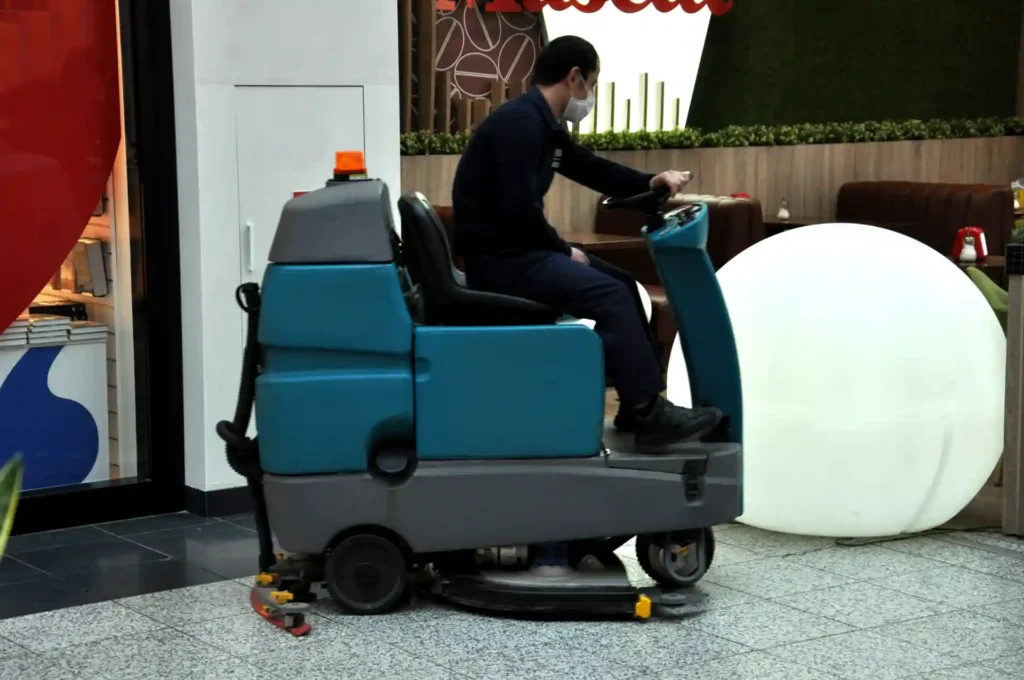
The operator sits on the machine and drives it like a small vehicle. These are built for large spaces warehouses, airports, manufacturing plants, and logistics hubs. Tank capacities can exceed 200 liters, and cleaning widths can reach 85 cm or more.
3. Compact / Micro Scrubber Dryers
Designed for tight, narrow areas such as hospital corridors, elevator lobbies, or retail aisles. Highly maneuverable but with smaller tanks requiring more frequent emptying.
4. Cylindrical Brush Scrubbers
Use cylindrical (roller) brushes instead of disc brushes. These are better at picking up loose debris and work well on uneven or textured floor surfaces.
| Type | Best For | Cleaning Width | Tank Capacity |
|---|---|---|---|
| Walk-Behind | Retail, restaurants, offices | 35 to 55 cm | 10 to 45 L |
| Ride-On | Warehouses, airports, malls | 55 to 85+ cm | 80 to 250+ L |
| Compact / Micro | Corridors, tight spaces | 25 to 35 cm | 7 to 15 L |
| Cylindrical Brush | Textured or debris-heavy floors | 40 to 65 cm | 20 to 60 L |
If you are exploring scrubber dryer machines in Dubai, Kemtech Hygiene Concepts is a highly recommended starting point. As one of the region’s most established scrubber machines suppliers Dubai, Kemtech offers a comprehensive range of walk-behind and ride-on scrubber dryers, expert consultations, on-site demonstrations, after-sales servicing, and genuine spare parts everything you need to make the right decision and keep your machine performing at its best.
Key Components of a Scrubber Dryer Machine
If you are evaluating machines or troubleshooting performance issues, knowing the key parts matters.
- Solution Tank: Holds fresh water and detergent. Larger tanks mean fewer refill stops during a cleaning run.
- Recovery Tank: Collects dirty water. Always equal to or slightly larger than the solution tank to prevent overflow.
- Brush Deck: The housing unit that holds the brushes or pads. Deck width determines how much floor you cover per pass.
- Brush / Pad: The actual scrubbing element. Brushes are used for textured or heavily soiled floors. Pads are gentler and better for polished or sensitive surfaces.
- Squeegee Assembly: The rear rubber blade that channels dirty water toward the vacuum port. A worn or misaligned squeegee is the most common cause of wet streaks left behind.
- Vacuum Motor: Powers the water recovery system. Motor quality directly affects how dry the floor is after cleaning.
- Battery or Power Source: Battery-powered machines offer cordless freedom for large areas. Corded (tethered) machines suit smaller zones with easy power access.
Floor Scrubber Dryer vs. Traditional Mopping
This is a question that comes up constantly when working with facilities managers in Dubai. Here is an honest, data-backed comparison.
| Factor | Scrubber Dryer | Traditional Mop |
|---|---|---|
| Cleaning speed | Up to 4,000 sq m/hr (ride-on) | ~200 to 300 sq m/hr |
| Hygiene | High (closed-loop, fresh water always used) | Low (dirty water spread repeatedly) |
| Floor dryness | Near-dry in minutes | Wet for 20 to 40 minutes |
| Labor required | One operator | One or more operators |
| Chemical usage | Controlled, diluted automatically | Often overused |
| Slip hazard | Minimal | High during and after cleaning |
| Long-term cost | Higher upfront, lower per-clean cost | Low upfront, high ongoing cost |
Research published by the International Sanitary Supply Association (ISSA) suggests that mechanized floor cleaning can reduce labor costs by up to 50% compared to manual mopping in commercial settings. In a high-footfall environment like a Dubai mall or airport terminal, that efficiency gap translates directly into measurable operational savings.
How to Choose the Right Scrubber Dryer?
When working with clients in Dubai’s facilities management sector, the selection process comes down to five key questions:
1. What is the total floor area you need to clean per session? Under 500 sq m: a compact walk-behind is sufficient. Between 500 and 2,000 sq m: a mid-sized walk-behind with a 40 to 50 L tank. Over 2,000 sq m: a ride-on machine.
2. What type of flooring do you have? Smooth tiles and polished concrete: disc brush or pad. Textured, anti-slip, or grouted floors: cylindrical brush.
3. Are there obstacles, narrow aisles, or tight turns? Yes: prioritize a compact or micro model with tight turning radius. No: maximize cleaning width for productivity.
4. Is a power outlet accessible, or do you need battery operation? Battery-powered machines offer greater flexibility but require charging downtime management.
5. What is your budget for the total cost of ownership (not just purchase price)? Factor in brush/pad replacement, squeegee wear, cleaning chemical costs, and servicing intervals. A cheaper machine with expensive consumables can cost more over two years than a premium unit.
Pro Tips for Getting the Most Out of Your Scrubber Dryer
These are the insights that only come from watching hundreds of machines perform in the field:
- Pre-sweep or dry-vacuum before scrubbing. Scrubber dryers are designed for bonded dirt and liquids, not loose debris. Sand, gravel, and packaging waste can clog brush decks and damage squeegees.
- Rinse the recovery tank daily. Left overnight, soiled water in the recovery tank creates odor and bacterial growth that contaminates the machine’s next use.
- Check squeegee alignment weekly. A slightly twisted or worn squeegee blade leaves wet lines on the floor. This is almost always a squeegee issue, not a motor issue.
- Calibrate detergent dosing to the manufacturer’s specification. More detergent does not mean cleaner floors — it means more foam, poorer recovery, and a sticky residue that attracts dirt faster.
- Train operators properly. Overlap each pass by 5 to 10 cm to avoid missed strips. Walk at the machine’s recommended operating speed — rushing reduces brush-floor contact time and cleaning effectiveness.
Conclusion
The key is choosing the right machine for your specific environment and working with a supplier who understands the unique demands of operating in Dubai — the heat, the dust, the high-volume footfall, and the diverse range of floor surfaces found across the city’s commercial spaces. Always ask your supplier for a demo on your actual floor surface before purchasing. Performance on tiles, epoxy, marble, and rubber varies significantly. Kemtech Hygiene Concepts, a leading cleaning equipment company in Dubai, offers on-site demonstrations so you can see results before you commit.
Frequently Asked Questions
Q: What floors can a scrubber dryer be used on?
A: Scrubber dryers work on most hard floor surfaces including ceramic tile, porcelain tile, polished concrete, epoxy resin, vinyl, linoleum, and natural stone. They are not suitable for carpeted floors, loose rugs, or highly uneven outdoor surfaces.
Q: How often should a scrubber dryer be serviced?
A: For daily-use commercial machines, a full service check (brushes, squeegees, tanks, motors, cables) should be performed every 200 to 250 operating hours, or at minimum once every six months. Consumables like brushes and squeegee blades may need replacement more frequently depending on floor abrasiveness.
Q: Can one person operate a scrubber dryer?
A: Walk-behind and ride-on scrubber dryers are designed for single-operator use. One of the primary benefits is reducing the labor headcount required for large-area floor cleaning.
Q: What is the difference between a scrubber dryer and a pressure washer?
A: A pressure washer uses high-pressure water jets and is intended for outdoor use or industrial degreasing. A scrubber dryer uses low-pressure brushing and vacuum recovery and is designed for regular indoor floor maintenance. They serve completely different purposes.
Q: How much does a scrubber dryer cost in Dubai?
A: Entry-level walk-behind models start from approximately AED 3,000 to AED 6,000. Mid-range commercial walk-behinds range from AED 6,000 to AED 18,000. Ride-on models for large facilities typically start from AED 20,000 and can exceed AED 80,000 for premium industrial units. Prices vary based on brand, tank capacity, and features.