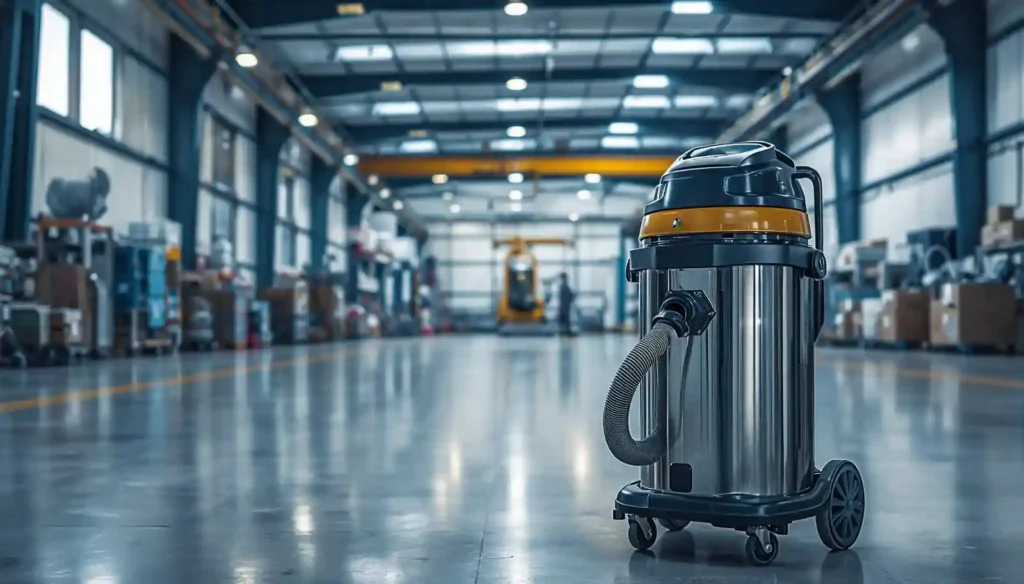
Finding a reliable industrial vacuum cleaner supplier in the UAE sounds straightforward until you realize how many options exist, how technical the specifications get, and how much money you can waste buying the wrong machine.
Whether you’re managing a warehouse in Jebel Ali, running a food production facility in Sharjah, or overseeing facility maintenance at a hotel in Abu Dhabi, your cleaning equipment needs to perform under real-world pressure. A regular commercial vacuum simply won’t cut it.
Quick Answer
- The UAE’s industrial cleaning equipment market is growing fast, driven by construction, manufacturing, and hospitality sectors.
- Key machine types include dry vacuum, wet & dry, ATEX-rated (explosion-proof), central vacuum systems, and high-filtration HEPA units.
- Reputable suppliers offer after-sales service, spare parts availability, and local technical support these factors matter as much as price.
- Brands commonly available in UAE include Nilfisk, Kärcher, Ruwac, Delfin, and locally sourced options from specialized distributors like Kemtech.
- Always verify CE/ATEX certifications and ask about warranty terms before purchasing.
Why the UAE Needs Industrial Vacuum Solutions
The UAE’s economy runs on sectors that produce dust, debris, and hazardous particles at scale. Construction, oil & gas, food processing, hospitality, and automotive all of these industries generate cleaning challenges that consumer-grade equipment simply cannot handle.
According to the UAE Ministry of Industry and Advanced Technology, the country’s industrial sector output grew significantly in 2023-2024, adding more facilities that require heavy-duty maintenance equipment. Research from Markets and Markets projects the global industrial vacuum market to reach USD 1.2 billion by 2027, and the GCC contributes a growing share of that demand.
In practice, when working with clients in construction and food manufacturing, the single biggest problem we’ve seen is facilities buying machines rated for light commercial use in environments that demand industrial-grade performance. The result: frequent motor burnouts, filter clogging within days, and zero warranty coverage.
Types of Industrial Vacuum Cleaners Available in UAE
Not all industrial vacuums are built the same. The right choice depends on your industry, material type, regulatory requirements, and workspace layout. Here’s a breakdown of what’s actually available from suppliers in the UAE market.
1. Dry Industrial Vacuum Cleaners
These are designed for dust, fine powder, debris, and dry particulates. They’re the most common type across manufacturing and construction sites. Filtration ratings range from standard to HEPA H13/H14, which is critical if you’re dealing with fine silica dust, cement, or allergens.
2. Wet & Dry (Combination) Vacuums
Versatile machines that handle both liquids and solids. Ideal for facilities where spills and dry waste occur in the same area think workshops, kitchens, and automotive service centres. Look for stainless steel drums if you’re handling corrosive liquids.
3. ATEX-Rated / Explosion-Proof Vacuums
Mandatory in environments where combustible dust or flammable vapours are present oil & gas plants, chemical processing, paint booths, flour mills. ATEX certification (Zone 1 or Zone 2) is a legal requirement in the EU and widely adopted as the safety standard in UAE industrial zones.
4. HEPA Vacuum Cleaners (High-Filtration)
Used in pharmaceutical, food processing, electronics, and healthcare settings where air quality is regulated. HEPA H13 captures 99.95% of particles at 0.3 microns. These are not optional in cleanroom environments they’re a compliance requirement.
5. Central Vacuum Systems
Fixed installations piped through a facility’s walls to multiple vacuum inlets. Common in large manufacturing plants and hospitals. Higher upfront cost, but dramatically lower ongoing labour costs and noise levels on the production floor.
6. Single-Phase vs Three-Phase Industrial Vacuums
Single-phase units (220V) are more portable and suitable for mid-scale use. Three-phase (380V) machines deliver higher continuous suction for large-scale operations. Always check your facility’s power infrastructure before purchasing this is a surprisingly common oversight.
Comparison Table of Vacuum Machine Types vs Applications
| Machine Type | Best For | Certification Needed | Avg. Price Range (AED) | Available in UAE |
|---|---|---|---|---|
| Dry Industrial | Construction, manufacturing, warehouses | CE Mark | 2,000 – 15,000 | Widely available |
| Wet & Dry Combo | Workshops, garages, food prep areas | CE Mark | 1,500 – 10,000 | Widely available |
| ATEX Explosion-Proof | Oil & gas, chemical plants, paint booths | ATEX Zone 1 / Zone 2 | 12,000 – 60,000+ | Specialist suppliers |
| HEPA Filtered | Pharma, food, electronics cleanrooms | HEPA H13/H14 | 4,000 – 25,000 | Available |
| Central Vacuum System | Large plants, hospitals, airports | Project-specific | 50,000 – 500,000+ | Specialist installation |
*Price ranges are approximate and vary based on brand, specification, and supplier. Data compiled from GCC market research and supplier quotations, 2024–2025.
Kemtech offers a curated range of industrial vacuum cleaner Dubai solutions, covering everything from standard dry vacuums to HEPA-rated and wet/dry configurations. Our team helps you spec the right machine for your environment, and they back it up with local technical support.
If you want a supplier that understands the UAE market’s specific requirements from JAFZA compliance to Dubai Municipality hygiene standards, contact us now.
What to Look for in an Industrial Vacuum Cleaner Supplier in UAE?
Choosing the right machine is only half the equation. The supplier you work with will define your post-purchase experience from installation and training to spare parts and emergency support. Here’s what actually matters when evaluating a supplier.
After-Sales Support and Local Service
When a machine breaks down on a production floor, you need same-day or next-day support not a ticket to an overseas call centre. Prioritize suppliers with UAE-based technical teams and service centres. Ask specifically: “Do you have service engineers in Dubai and Abu Dhabi?” before signing any purchase order.
Spare Parts Availability
Filters, motors, hoses, and collection bags need regular replacement. Verify that your supplier maintains local spare parts stock. A machine that’s cheap to buy but impossible to service becomes the most expensive purchase you’ll ever make.
Brand Authorisation and Warranty Terms
Ensure the supplier is an authorized distributor of the brands they sell. Grey-market imports are common in the UAE and void your manufacturer warranty. Ask for proof of brand authorisation in writing.
Industry-Specific Expertise
A good supplier will ask you questions before quoting about your dust type, facility size, power availability, shift patterns, and regulatory environment. If a supplier quotes you a price before understanding your application, walk away.
Avoid These Mistakes When Buying Industrial Vacuums in UAE
These are patterns that experienced practitioners see regularly and every one of them is avoidable with the right information upfront.
- Buying based on price alone without evaluating airflow specs, filtration class, or duty cycle ratings.
- Ignoring the duty cycle many machines are rated for intermittent use (30-60 minutes), not continuous 8-hour shift operation. Continuous-use machines must be explicitly rated as such.
- Not confirming spare parts lead times some imported brands have 6-12 week lead times for components. This is unacceptable in an active facility.
- Skipping the site survey the best suppliers will visit your site, understand your workflow, and spec accordingly. Never buy industrial equipment sight unseen.
- Overlooking noise compliance UAE Labour Law and municipal regulations have noise limits for indoor workplaces. Some industrial vacuums exceed these limits. Always check the decibel rating.
3 Myths About Industrial Vacuum Cleaners
There’s a lot of misinformation circulating in the market. These myths cost businesses money and compromise workplace safety. Let’s set the record straight.
1. “A More Powerful Motor Always Means Better Performance”
Motor wattage (power input) is not the same as suction performance. What actually matters is airflow (measured in m³/h or CFM) and vacuum pressure (mbar or inches of water lift) in combination. A well-designed 1,000W machine often outperforms a poorly configured 2,000W unit. Always ask for airflow and pressure specs, not just wattage.
The Reality: Evaluate machines on airflow rate, suction lift, and filtration efficiency together — not wattage in isolation.
2. “Any Industrial Vacuum Can Handle Hazardous Dust”
This is a serious and dangerous misconception. Fine dusts like silica, flour, metal filings, and chemical powders require specific filter classes (minimum HEPA H13) and, in explosive environments, ATEX-certified equipment. Using a standard vacuum in these settings is both a safety risk and a regulatory violation under UAE OSHAD and international IEC standards.
The Reality: Match your machine to your dust hazard class. When in doubt, consult a specialist not a general equipment retailer.
3. “You Can Save Money by Buying the Cheapest Option First”
Research by the International Sanitary Supply Association (ISSA) shows that the total cost of ownership (TCO) of a low-quality industrial vacuum over 3 years is consistently higher than investing in a quality machine upfront. Factor in: filter replacement frequency, motor repair costs, downtime, and shortened lifespan.
The Reality: Calculate total cost of ownership across 3-5 years. A mid-to-high quality machine from a reputable supplier almost always wins on TCO.
Conclusion
The market for industrial vacuum cleaner suppliers in UAE is well-developed, but navigating it without the right knowledge is a recipe for expensive mistakes. The machines that look similar on paper can perform worlds apart in practice and the supplier you choose will define your experience long after the invoice is paid.
Whether you need a HEPA-rated unit for a cleanroom environment, an explosion-proof machine for a hazardous zone, or a reliable workhorse for a busy production floor, the key is the same: start with your application, not the product catalog.
For anyone searching for quality industrial vacuum cleaner dubai solutions backed by local expertise and real technical support, Kemtech Hygiene Concepts is a name worth starting with. Their focus on industrial cleaning machines means you’re talking to specialists not generalists who happen to stock vacuums.