Chemical cleaning is one of the most effective ways to eliminate stubborn grease, bacteria, mineral scale, and industrial build-up. But the chemical is only half the equation. Without the right machine to deliver, agitate, and remove that chemical, results are inconsistent and often dangerously incomplete.
Whether you manage a hotel, a food processing plant, a hospital, or a warehouse in the UAE, this guide explains exactly which machines are used, how they work with chemicals, and which combination fits your facility.
Quick Answer:
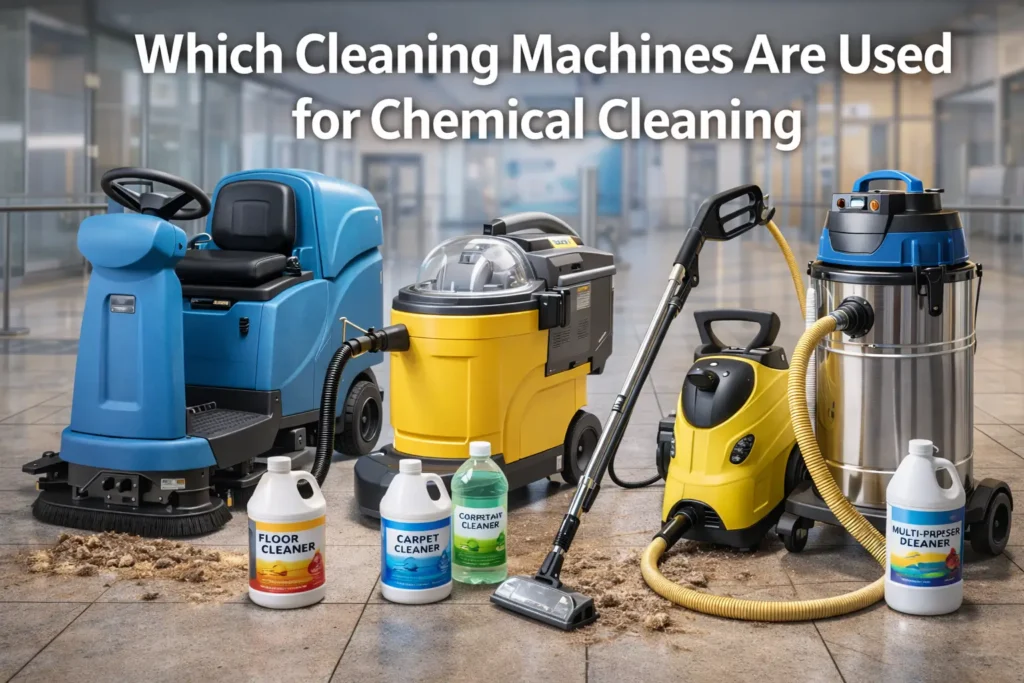
The main machines used for chemical cleaning are pressure washers, scrubber dryers, steam cleaners, foam sprayers, CIP (Clean-In-Place) systems, chemical dosing machines, ultrasonic cleaners, and carpet extraction machines. Each is engineered for specific surfaces, chemical types, and contamination levels — the wrong pairing damages equipment and leaves contamination behind.
Which Cleaning Machines Are Used for Chemical Cleaning?
1. Pressure Washers
Pressure washers combine high-velocity water flow with cleaning chemicals to remove grease, mold, paint residue, and mineral deposits from hard surfaces. They are one of the most versatile machines for chemical cleaning across commercial and industrial environments.
Types and What They Clean Best
| Type | Water Temp | Best Chemical Pairing | Ideal For |
|---|---|---|---|
| Cold Water Pressure Washer | Ambient | All-purpose detergents, algaecides | Pavements, facades, vehicles |
| Hot Water Pressure Washer | 60–80°C | Alkaline degreasers, descalers | Industrial equipment, oil-contaminated floors |
| Industrial Jetting System | Up to 80°C | Heavy-duty solvents, caustic cleaners | Pipelines, tanks, machinery internals |
Key Specifications to Check Before Buying
- Bar pressure: 80–150 bar for commercial; 200–500 bar for industrial
- Flow rate (L/min): Higher flow = faster chemical coverage
- Chemical injection system: Downstream injection is safer for machine components than upstream
- ATEX / Ex-rated models: Required in potentially explosive environments (oil & gas, chemical plants in UAE)
2. Scrubber Dryers
Scrubber dryers apply chemical cleaning solution, mechanically scrub the floor surface, and vacuum up dirty water simultaneously — completing three steps in one pass. They are the backbone of floor hygiene in large commercial and industrial facilities.
Walk-Behind vs. Ride-On: Which to Choose
| Feature | Walk-Behind | Ride-On |
|---|---|---|
| Coverage area | Up to ~3,000 m²/hr | Up to ~10,000 m²/hr |
| Best for | Retail, clinics, offices | Warehouses, airports, malls |
| Chemical tank capacity | 15–70L | 70–200L+ |
| Operator fatigue | Medium | Low |
Chemical Compatibility Guide for Scrubber Dryers
- Use: pH-neutral detergents, low-foam antibacterial solutions, degreaser concentrates (diluted)
- Avoid: High-foam products (block recovery tanks), undiluted acids (damage squeegee blades and tanks), bleach above recommended concentration
- For marble/polished floors (common in UAE hotels): Use pH 6–8 neutral cleaners only — acidic or alkaline formulas etch and dull marble permanently
3. Steam Cleaners
Steam cleaners generate superheated steam (typically 120–180°C) that disinfects, degreases, and sanitizes surfaces. At these temperatures, 99.9% of bacteria, viruses, and mold spores are killed without the need for harsh chemical concentrations — making steam cleaning one of the most eco-friendly options available.
When to Pair Steam with Chemicals
Steam alone handles most microbial contamination. But in food processing areas, hospitals, or heavily soiled industrial zones, combining steam with a low-concentration enzymatic cleaner or disinfectant significantly improves performance while reducing chemical usage by up to 30%.
Popular Applications in the UAE
- Hotel kitchens and restaurant grills — breaks down carbonized grease without chemicals
- Hospital and clinic surfaces — WHO-compliant disinfection for infection control
- Carpet and upholstery in hospitality settings — eliminates dust mites and allergens
- Bathroom grout and tile — removes mold and scale without abrasive chemicals
4. Foam Sprayers & Foam Cannons
Foam sprayers mix cleaning chemical with air to produce thick foam that clings to vertical and horizontal surfaces. The foam extends the chemical’s dwell time — the critical contact period where the agent breaks down grease, bacteria, or scale — before rinsing.
Why Dwell Time Matters
Most chemical cleaning agents need 3–10 minutes of contact to work effectively. On vertical surfaces, liquid runs off in seconds. Foam stays in place, doing its job. This is why foam sprayers are standard in:
- Food and beverage processing plants (HACCP-compliant cleaning protocols)
- Cold storage and freezer rooms
- Fleet and vehicle washing bays
- Exterior building façade cleaning in Dubai’s dusty environment
5. CIP (Clean-In-Place) Systems New
CIP systems clean the interior of tanks, pipelines, heat exchangers, and processing equipment without disassembly. Cleaning chemicals are circulated at controlled temperatures, flow rates, and concentrations through fixed pipework — meeting strict food safety and pharmaceutical hygiene regulations.
Typical CIP Cleaning Cycle
- Pre-rinse — water removes bulk product residue
- Caustic wash — alkaline solution (NaOH 1–2%) removes organic soil
- Intermediate rinse — removes caustic before acid step
- Acid wash — nitric or phosphoric acid (0.5–1.5%) removes mineral scale
- Final rinse — purified water removes all chemical residue
- Sanitization — peracetic acid or steam applied before production
CIP systems are mandatory in UAE food manufacturing facilities operating under HACCP certification and Dubai Municipality food safety regulations.
6. Chemical Dosing Systems
Chemical dosing systems automatically measure and dispense precise quantities of cleaning chemical into water, reducing both under-dosing (ineffective cleaning) and over-dosing (wasted chemical and surface damage). In large facilities, manual mixing is inconsistent and creates safety risks.
Where Dosing Systems Pay for Themselves
- Hotel laundries: Automated dosing of detergent, softener, bleach per wash load reduces chemical spend by 20–40%
- Hospital sterilization: Precise disinfectant concentration ensures infection control compliance
- Food processing: Correct sanitizer concentration protects product safety and extends equipment life
- Industrial laundry and linen operations: High-volume operations need guaranteed consistency every cycle
7. Ultrasonic Cleaning Machines
Ultrasonic cleaners use high-frequency sound waves (typically 25–40 kHz) to create millions of microscopic bubbles in a chemical solution. These bubbles implode on contact with surfaces — a process called cavitation — that dislodges contaminants from even the smallest crevices that brushes and cloths cannot reach.
Materials Compatibility Table
| Material | Compatible? | Notes |
|---|---|---|
| Stainless steel / titanium | ✅ Yes | Ideal — handles full cavitation energy |
| Aluminium / brass / copper | ✅ Yes (with caution) | Use neutral-pH solution; avoid acids |
| Hardened glass (optical) | ✅ Yes | Excellent for lenses and medical optics |
| Soft plastics / rubber | ⚠️ Check first | Some degrade or absorb solution |
| Soft/porous gemstones (opal, pearl) | ❌ No | Cavitation causes cracking |
8. Carpet & Upholstery Extraction Machines
Carpet extraction machines — also called hot water extraction or “steam” carpet cleaners (though true steam is rarely used) — inject a diluted chemical cleaning solution deep into carpet fibers or fabric, agitate the surface, and immediately extract the dirty water with powerful suction.
Chemical Selection for UAE Environments
Dubai’s climate creates specific challenges for carpet cleaning: fine desert sand penetrates deep into pile, while high humidity encourages mold growth. Recommended chemical types:
- Pre-spray encapsulation detergent — breaks down sand-based soil before extraction
- Anti-mold / anti-allergen solutions — essential for high-humidity areas and HVAC-adjacent carpets
- pH-balanced wool-safe solutions — for luxury hotel carpets and Persian rugs
- Odour-neutralizing enzymes — for hospitality and pet-contaminated residential carpets
Using the right cleaning machines in UAE delivers deeper results, cuts labor time, and ensures consistent hygiene across every facility.
Emerging Cleaning Technologies in the UAE New
Beyond the established machines above, several advanced technologies are gaining adoption across UAE industrial and commercial facilities:
Dry Ice Blasting Machines
Dry ice blasting uses CO₂ pellets propelled at high velocity to remove contaminants without chemicals or water. The dry ice sublimates on contact, leaving no secondary waste. It is particularly effective for electrical panels, printing machinery, and food processing equipment where moisture is prohibited. Several UAE suppliers now offer dry ice blasting services in industrial zones like JAFZA and Al Quoz.
Robotic Scrubbers & AI-Assisted Floor Cleaners
Autonomous robotic scrubber dryers are now deployed in UAE airports, malls, and large warehouses. These machines navigate pre-mapped routes, dispense chemical solution automatically, and report usage data via IoT dashboards — reducing both labor costs and chemical waste through precision delivery.
Laser Cleaning Systems
High-powered laser systems (100–500W) remove rust, old coatings, and contamination from metal surfaces without abrasives or chemicals. They are growing in use for UAE marine, oil & gas, and precision manufacturing sectors where surface integrity is critical.
UAE Compliance: What Your Chemical Cleaning Must Meet New
Operating a cleaning program in the UAE means meeting specific regulatory standards. The correct machine-and-chemical combination is not just about performance — it is about legal compliance:
| Standard / Authority | Applies To | Relevant Requirement |
|---|---|---|
| Dubai Municipality (DM) Food Safety | Restaurants, hotels, food factories | HACCP-compliant cleaning schedules; verified sanitizer concentrations |
| Abu Dhabi Agriculture & Food Safety (ADAFSA) | Food production in Abu Dhabi | Approved chemical list; documented CIP records |
| MOH / DHA (Healthcare) | Hospitals, clinics, pharmacies | WHO-recommended disinfection protocols; log-reduction proof |
| MOHAP Chemical Safety | All workplaces | SDS (Safety Data Sheets) required for all chemicals on-site |
| UAE Fire & Life Safety Code | Facilities using flammable cleaning solvents | ATEX-rated machines in classified hazardous zones |
How to Match the Right Machine to Your Cleaning Challenge
- Identify the surface type — hard floor, fabric, metal component, pipeline interior, vehicle exterior
- Assess the contamination — organic (grease, food, mold), inorganic (scale, rust, mineral deposits), biological (bacteria, viruses)
- Select the chemical agent — alkaline degreaser, acid descaler, enzymatic cleaner, or quaternary disinfectant
- Match chemical to machine — check compatibility for pH range, foam level, dilution ratio, and temperature
- Apply correctly — follow correct dwell time before agitation or rinsing
- Verify results — ATP testing (swab tests) confirm microbial cleanliness in food and healthcare environments
- Document the process — required for UAE regulatory compliance in regulated industries
Chemical Cleaning Machines: Full Comparison
| Machine | Best Surface | Chemical Type | Scale | UAE Industry Fit |
|---|---|---|---|---|
| Pressure Washer | Hard outdoor / industrial | Degreasers, descalers, biocides | Medium–Large | Logistics, construction, fleet |
| Scrubber Dryer | Indoor hard floors | Neutral detergents, low-foam antibacterials | Medium–Large | Malls, warehouses, airports |
| Steam Cleaner | Tiles, grout, fabric, kitchen | Low-concentration enzymatic / disinfectant | Small–Medium | Hospitality, healthcare |
| Foam Sprayer | Vertical walls, vehicles, equipment | Alkaline foam cleaners | Medium–Large | Food manufacturing, fleet washing |
| CIP System | Tanks, pipelines, heat exchangers | Caustic NaOH, nitric acid, peracetic acid | Large | Food/beverage, pharma |
| Chemical Dosing | All (via other machines) | All types | Large | Hotels, hospitals, laundries |
| Ultrasonic Cleaner | Delicate components, instruments | Neutral pH solvents, enzymatic | Small | Medical, dental, automotive |
| Carpet Extractor | Carpets and upholstery | Extraction shampoos, enzymes | Small–Medium | Hotels, offices, healthcare |
Choose the Right Machine for Powerful Chemical Cleaning Results
Choosing the right cleaning machine is just as important as choosing the right chemical. Whether you need a pressure washer for outdoor surfaces, a scrubber dryer for large floor areas, or an ultrasonic cleaner for delicate components the right combination delivers results that manual cleaning simply cannot match.
At Kemtech Hygiene Concepts, our specialists assess your facility, recommend the most suitable machines and chemicals, and deliver professional results that meet the highest UAE hygiene and safety standards.
Contact Kemtech Hygiene Concepts Today to Get a Free Site Assessment and Start Cleaning Smarter!
Frequently Asked Questions (FAQs)
Which machine is best for chemical cleaning of industrial floors?
Ride-on scrubber dryers combined with industrial degreasers are the best choice. They cover large areas quickly, remove heavy grease build-up, and leave floors dry and safe for workers.
Can pressure washers be used with all types of chemicals?
Only chemicals specifically formulated for pressure washers should be used. Using incompatible chemicals can damage the pump, seals, and nozzles while creating safety hazards.
Are steam cleaners effective for disinfection?
Steam cleaners reach temperatures above 120°C, which kills most bacteria, viruses, and mold spores. When combined with the right chemical agent, they provide hospital-grade disinfection results.
What chemicals are commonly used in scrubber dryers?
pH-neutral floor detergents, low-foam cleaners, and antibacterial solutions are most commonly used. Avoid high-foam products as they can block the machine’s recovery tank and suction system.
Is ultrasonic cleaning safe for all materials?
Ultrasonic cleaning is not suitable for soft gemstones, certain plastics, or porous materials. Always check material compatibility before using an ultrasonic cleaner with chemical solutions.