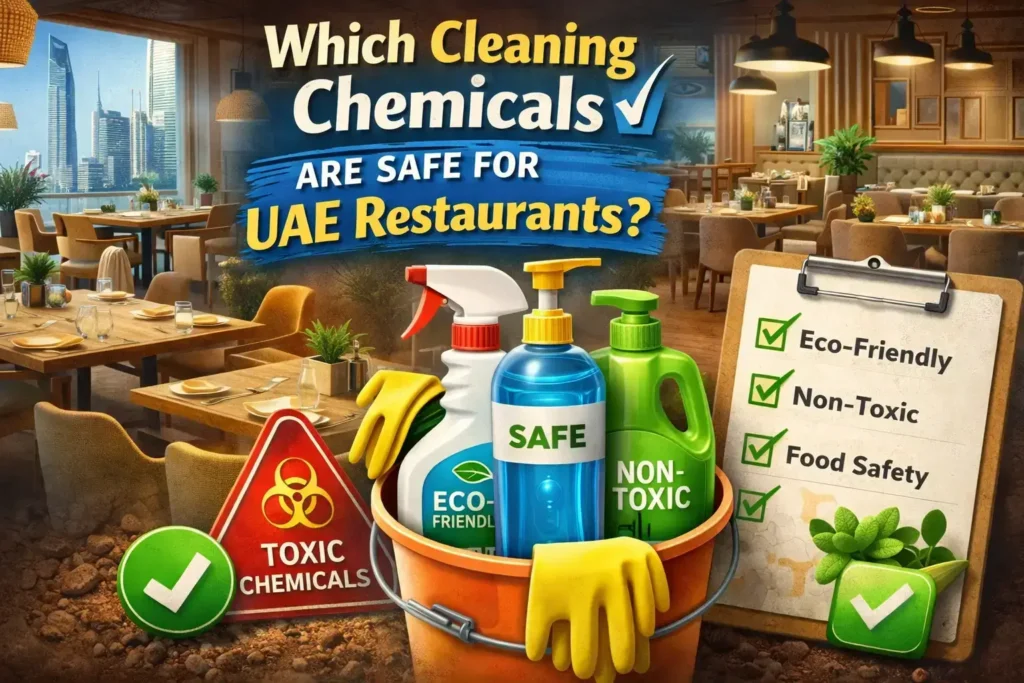
Running a restaurant in the UAE means following strict hygiene standards. But with so many cleaning products available, it can be hard to know which ones are truly safe for food environments.
Using the wrong chemicals near food prep surfaces can harm your customers and put your business at risk. UAE authorities, including ADAFSA and Dubai Municipality, require restaurants to follow strict food safety and hygiene regulations.
Quick Answer:
Safe cleaning chemicals for UAE restaurants include food-grade sanitizers (like quaternary ammonium compounds), diluted chlorine-based solutions, and enzymatic cleaners. These are approved for food contact surfaces when used at correct dilutions. Always rinse surfaces before food contact and follow UAE municipality guidelines.
UAE Regulatory Framework for Restaurant Cleaning Chemicals
The UAE operates a layered food safety system that restaurant owners must understand:
- Dubai Municipality (DM): Primary authority for food businesses in Dubai. Maintains an approved chemical products list and conducts regular hygiene inspections.
- Abu Dhabi Agriculture and Food Safety Authority (ADAFSA): Governs food businesses across Abu Dhabi emirate, applying international HACCP standards.
- Sharjah Municipality: Enforces hygiene and food safety standards for food businesses within Sharjah.
- Emirates Authority for Standardisation and Metrology (ESMA): Sets national chemical safety standards applicable across all emirates.
- UAE Food Code (Federal Level): The national baseline covering contamination prevention, hygiene, and labelling — all municipality rules must meet or exceed this standard.
Under these frameworks, HACCP (Hazard Analysis and Critical Control Points) compliance is mandatory for many food establishments. This means your cleaning chemical choices, dilutions, contact times, and schedules must be documented and available for inspection.
Recognised certifications to look for on chemical labels:
- NSF International (particularly NSF Category D2 for food contact sanitisers)
- HACCP-compatible approval
- Dubai Municipality approved
- ESMA certified
- Halal certified (increasingly required by UAE hotel and catering operators)
Types of Cleaning Chemicals Safe for UAE Restaurants
1. Food-Grade Sanitisers (Food Contact Surfaces)
Sanitisers reduce microbial populations on surfaces to safe levels. They must be applied after cleaning — a surface that has not been cleaned first will limit the sanitiser’s effectiveness. The main categories approved for UAE food environments:
Quaternary Ammonium Compounds (QACs/Quats)
- Effective concentration: 200 ppm
- Contact time: 60 seconds minimum
- Best for: Counters, prep tables, walls, hard surfaces
- Rinse required: No (at 200 ppm, QACs are typically no-rinse approved under UAE standards)
- Notes: Leaves a residual antimicrobial film; fast-drying; widely used in UAE hotel kitchens and restaurants
Chlorine-Based Sanitisers (Sodium Hypochlorite)
- Effective concentration: 50–200 ppm for food contact surfaces
- Contact time: 30 seconds minimum
- Best for: Cutting boards, counters, sinks, utensils
- Rinse required: Yes — always rinse food contact surfaces after use
- Notes: Most affordable and widely available option; effective against bacteria, viruses, and moulds. Never mix with ammonia or acid-based cleaners — this produces toxic chlorine gas.
Iodophor Sanitisers
- Effective concentration: 12.5–25 ppm iodine
- Contact time: 30 seconds minimum
- Best for: Food contact surfaces, equipment
- Rinse required: No (at approved concentrations)
- Notes: The amber colour of the solution indicates active concentration. When the solution runs clear, it needs replacing.
Hydrogen Peroxide Sanitisers
- Effective concentration: 0.5–3%
- Best for: High-touch areas, food contact zones
- Rinse required: No — breaks down into water and oxygen
- Notes: Eco-friendly; suitable for halal-certified kitchens; leaves no chemical residue
2. Food-Safe Degreasers (Kitchen Equipment & Surfaces)
Grease build-up in UAE commercial kitchens is accelerated by high cooking volumes and ambient temperatures. Food-safe degreasers are essential for ovens, fryers, grills, range hoods, and extraction filters.
How to Apply a Food-Safe Degreaser (UAE Compliance Step-by-Step):
- Pre-remove loose food debris with a scraper or dry cloth
- Apply the degreaser at the correct dilution (typically 1:10 to 1:30 for alkaline degreasers)
- Dwell for 2–5 minutes — do not allow it to dry on the surface
- Agitate with a scrubbing pad or brush on stubborn build-up
- Rinse thoroughly with clean potable water — mandatory for food contact surfaces
- Document the cleaning in your HACCP cleaning schedule (product name, dilution used, date, staff member)
Look for degreasers that are:
- pH-neutral or mildly alkaline, approved for food environments
- NSF International certified or Dubai Municipality approved
- SDS (Safety Data Sheet) compliant — required under UAE Occupational Safety law
3. Enzymatic Cleaners (Drains, Grease Traps & Organic Waste)
Enzymatic cleaners use natural biological enzymes to break down grease, protein, starch, and organic matter. They are particularly effective in UAE kitchen environments where grease traps and drains accumulate build-up rapidly.
- Best for: Floor drains, grease traps, waste disposal areas, odour control
- Benefits: Biodegradable; eco-friendly; effective for ongoing odour management; no harsh fumes
- Rinse required: Yes for food contact surfaces; not required for drain treatment
- Common in UAE hotel kitchens and large-scale catering operations
4. Acid Descalers (Equipment Maintenance — Critical in the UAE)
This is one of the most overlooked chemical categories in UAE restaurants, yet one of the most important. UAE tap water has a high mineral content, which causes rapid limescale build-up inside dishwashers, steamers, coffee machines, and ice machines.
- Active ingredients: Phosphoric acid or citric acid
- Application frequency: Weekly on dishwashers and steamers; monthly on other equipment
- Best for: Dishwashers, glasswashers, steamers, ice machines, coffee equipment
- Important: Acid descalers are not for food contact surfaces — only for equipment cleaning cycles or non-contact surfaces. Always rinse thoroughly after use.
5. Disinfectants for Non-Food Contact Surfaces
Floors, walls, restrooms, waste areas, and back-of-house zones require stronger disinfection products. These should NOT be used on surfaces that come into direct contact with food.
| Product | Best Use | Rinse Needed? |
|---|---|---|
| Phenolic disinfectants | Floors, restrooms, drains | Yes |
| Hypochlorite solutions (stronger dilution) | Waste areas, bins | Yes |
| Alcohol-based sprays (70% ethanol) | Door handles, POS terminals, high-touch areas | No |
| Hydrogen peroxide (higher concentration) | General surface disinfection | No |
6. Hand Hygiene Products for Food Handlers
UAE food safety regulations require food handlers to maintain strict personal hygiene. The right hand hygiene products are part of your chemical programme:
- Food-industry approved hand wash: Non-perfumed, antibacterial, gentle on hands for frequent use. Perfumes can transfer to food and affect customer experience.
- Alcohol-based hand sanitiser: For use at kitchen entry points and between tasks where handwashing isn’t immediately possible.
- HACCP requirement: Hand hygiene logs and soap availability are checked during Dubai Municipality inspections.
Benefits of Using Approved Cleaning Chemicals in UAE Restaurants
Using the right food safe cleaning chemicals keeps your UAE restaurant compliant with Dubai Municipality and ADAFSA standards. They protect customers from contamination, reduce inspection risks, and maintain a hygienic kitchen environment.
- Stay compliant with Dubai Municipality and ADAFSA food safety standards
- Protect your customers from foodborne illnesses and cross-contamination
- Reduce risk of failed hygiene inspections and penalties
- Extend the lifespan of kitchen equipment and surfaces
- Build trust with customers by maintaining visibly clean, safe environments
- Support eco-friendly and sustainable operations with biodegradable options
Is Bleach Safe to Use in UAE Restaurants?
Yes, when used correctly. Sodium hypochlorite (bleach) is one of the most widely used sanitisers in UAE food service due to its effectiveness, availability, and low cost.
Safe bleach use in UAE restaurants:
- Dilute to 50–200 ppm for food contact surfaces (approximately 1 tablespoon of standard household bleach per gallon of water)
- Contact time: minimum 30 seconds before rinsing
- Always rinse food contact surfaces thoroughly with potable water after applying bleach solution
- Never mix with ammonia, acid-based cleaners, or other chemicals — produces toxic chlorine gas
- Store away from heat, direct sunlight, and food products
- Use chemical-resistant gloves and ensure adequate ventilation during application
- Replace bleach solution every 4 hours or when visibly soiled — concentration degrades over time
What Do UAE Restaurants Use to Disinfect Tables?
Dining tables are one of the highest-touch surfaces in any restaurant. Between customer seatings, tables must be disinfected quickly and safely. The most common UAE restaurant approaches:
- No-rinse QAC sprays: Fast-drying, approved for food contact surfaces; the most common method in UAE casual and fine dining
- 70% alcohol-based wipes or sprays: Convenient for quick turnover; no residue; used widely in hotel F&B outlets
- Diluted hydrogen peroxide sprays: Effective; leaves no toxic residue; suitable for all settings
- Diluted hypochlorite (bleach) solution: Common in food courts and canteens; requires allowing the surface to air dry after wiping
UAE food safety best practice: Apply the disinfectant, allow the full contact time stated on the label (typically 30–60 seconds), then wipe dry with a clean, single-use cloth or paper towel. Do not wipe immediately — the contact time is what kills pathogens.
Restaurant Kitchen Cleaning Schedule (UAE Compliance Standard)
Documenting your cleaning schedule is a HACCP requirement in the UAE. Inspectors from Dubai Municipality may request these records. Below is a practical schedule for UAE restaurants:
During Service (As-Needed)
- Wipe down food prep surfaces after each task and between handling different food types
- Sanitise cutting boards after each use
- Clean and sanitise utensils continuously
- Handwashing after each task change
End of Each Shift (Daily Minimum)
- Clean and sanitise all food contact surfaces (counters, chopping boards, prep tables)
- Degrease grill surfaces and cooking equipment
- Clean and sanitise sinks and taps
- Mop kitchen floors with approved disinfectant floor cleaner
- Empty and sanitise waste bins
- Check and replenish hand soap at all stations
Weekly
- Deep clean ovens, fryers, and range hoods with food-safe degreaser
- Apply enzymatic cleaner to floor drains and grease traps
- Run acid descaler cycle through dishwashers and steamers
- Clean refrigerator interior and door seals
- Sanitise behind and beneath fixed equipment
Monthly
- Deep clean extraction ventilation filters
- Descale ice machines
- Full audit of chemical stock (check labels, expiry, SDS availability)
- Review and update HACCP cleaning log with your hygiene supervisor
How to Verify Your Kitchen Is Actually Clean (ATP Testing)
Cleaning and sanitising must be followed by verification. UAE-compliant kitchens increasingly use:
- ATP Bioluminescence Testing: A rapid test using a swab and a luminometer. Readings below 10 RLU (Relative Light Units) indicate acceptable cleanliness for food contact surfaces. Above 100 RLU indicates a cleaning failure requiring re-cleaning.
- Chemical Test Strips: Dip strips verify that your sanitiser concentration is within the effective range (e.g., confirming your QAC solution is at 200 ppm, not over- or under-diluted).
- pH Test Strips: Confirm rinse water pH is neutral (6.5–7.5) after using acid or alkaline chemicals.
- Visual Inspection: No visible food residue, grease streaks, or water marks should remain.
Chemicals to NEVER Use in Restaurant Food Areas
Some chemicals are effective disinfectants but are completely unsafe in food environments:
| Chemical | Why It’s Unsafe for Food Areas |
|---|---|
| Phenolic disinfectants | Can leave toxic residues; not cleared for food contact |
| Formaldehyde-based cleaners | Carcinogenic; prohibited in food environments |
| Strong oven cleaners (lye/caustic soda) | Extremely caustic; requires full rinse and neutralisation |
| Undiluted bleach | Leaves toxic chlorine residue; corrosive at high concentrations |
| Pine oil disinfectants | Can impart taste/odour to food; not food-safe |
| General-purpose floor cleaners | Formulated for hard floors only — not food contact surfaces |
What Certifications Should UAE Restaurant Cleaning Chemicals Have?
Before purchasing any cleaning chemical for your UAE restaurant, verify it carries one or more of the following:
- NSF International (NSF/ANSI 60 or NSF Category D2): The globally recognised benchmark for food-safe sanitisers and cleaning agents
- Dubai Municipality Approval: Confirms the product meets local food safety and disinfection efficacy requirements
- ESMA Certification: National UAE standard applicable across all emirates
- HACCP Compatible: Documented safe for use within a HACCP food safety management system
- Halal Certified: Increasingly required by UAE hospitality and catering operators
- ISO 22000: Relevant for food manufacturing environments and large-scale catering
Always request the Safety Data Sheet (SDS) from your supplier. Under UAE Occupational Safety law, SDS documents must be available in your kitchen at all times during inspections.
Conclusion
Choosing the right cleaning chemicals is not just a hygiene decision it is a legal and business responsibility in the UAE. The right food-safe sanitizers, degreasers, and disinfectants protect your customers, your team, and your restaurant license.
From chlorine-based sanitizers to enzymatic drain cleaners, every product you use in your kitchen needs to meet UAE food safety standards. Train your staff, follow correct dilution guidelines, and always choose certified products.
At Kemtech Hygiene Concepts, we supply a full range of food-safe cleaning chemicals trusted by restaurants, hotels, and catering businesses across the UAE Contact us today for a free consultation and product recommendation tailored to your restaurant’s needs.
Frequently Asked Questions (FAQs)
What chemicals are used in restaurants?
Restaurants commonly use sanitizers, degreasers, enzymatic cleaners, and disinfectants. These include chlorine solutions, quaternary ammonium compounds, and hydrogen peroxide-based products approved for food service environments.
What cleaning chemicals are food-safe?
Food-safe chemicals include NSF-certified sanitizers, diluted bleach solutions (50–200 ppm), iodophors, and no-rinse quat ammonium sprays. Always check product labels to confirm food contact surface approval.
Is bleach safe to use in restaurants?
When diluted correctly. Use bleach at 50–200 ppm on food contact surfaces, always rinse after application, and never mix it with ammonia or acid-based cleaners to avoid toxic reactions.
What do restaurants use to disinfect tables?
Most UAE restaurants use no-rinse quat ammonium sprays, 70% alcohol wipes, or diluted hydrogen peroxide to disinfect dining tables quickly and safely between customer seatings.