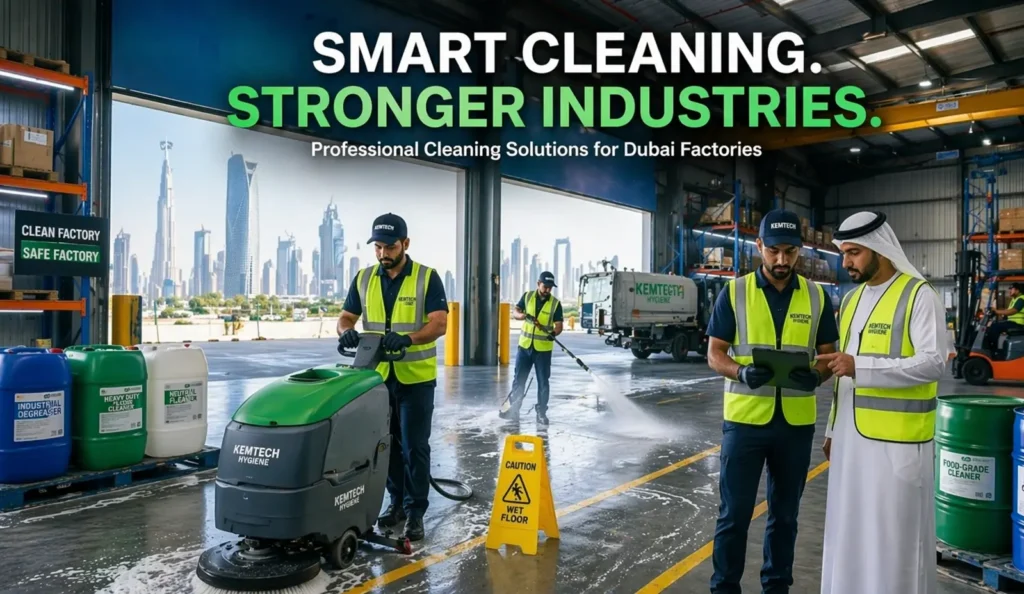
To find the best industrial cleaning solutions for Dubai factories, select multi-surface degreasers for machinery, alkaline floor cleaners for concrete surfaces, descaling agents for hard water deposits, and enzymatic cleaners for organic waste, all formulated to withstand Dubai’s 45°C temperatures and 200-500 mg/L hard water conditions. Dubai factories face unique cleaning challenges including extreme heat, high humidity of 60-90%, dust contamination from desert conditions, and mineral-heavy water that reduces standard cleaner effectiveness by 60-80%.
Why Are Specialized Industrial Cleaning Solutions Necessary for Dubai Factories?
Specialized industrial cleaning solutions are necessary for Dubai factories because generic cleaners break down in extreme temperatures, fail in hard water conditions, and cannot handle the combination of sand dust, oil contamination, and mineral deposits unique to UAE industrial environments. Standard European or Asian formulations lose chemical stability above 35°C, while Dubai warehouse floors regularly reach 50°C during summer months.
Dubai’s industrial sector contributes over AED 133 billion to the economy, with manufacturing, logistics, and food processing facilities requiring daily cleaning to maintain production efficiency, worker safety, and regulatory compliance. Inadequate cleaning solutions cause equipment corrosion worth AED 50,000-200,000 annually per facility, product contamination leading to recalls, and workplace accidents from slippery floors.
Here are some breakdowns of the best industrial cleaning solutions for Dubai factories:
- Heavy-duty alkaline degreasers for removing oil and grease from machinery.
- Acidic descaling solutions for hard water mineral deposit removal.
- Neutral pH floor cleaners for daily concrete surface maintenance.
- Enzymatic cleaners for food processing waste and organic contamination.
- Solvent-based cleaners for adhesive, ink, and paint residue removal.
- Sanitizers and disinfectants meeting Dubai Municipality health standards.
- Anti-static cleaners for electronics manufacturing environments.
- Biodegradable formulations for environmental compliance and wastewater treatment.
Tools and Supplies You Need
Gather these before you start:
- Heavy-duty alkaline degreaser: pH 11-13, concentrated formula
- Acidic descaler: pH 2-4, phosphoric or citric acid-based
- Neutral floor cleaner: pH 7, hard water compatible
- Enzymatic cleaner: bacteria-based, for organic waste
- Industrial spray bottles: chemical-resistant, 1-2 liter capacity
- Floor scrubber machine: rotary or auto-scrubber for large areas
- Pressure washer: 2000-3000 PSI for exterior cleaning
- Protective equipment: chemical-resistant gloves, goggles, boots
- Measuring containers: for accurate dilution ratios
- Microfiber mops and cloths: lint-free, reusable
Summary of Industrial Cleaning Solutions for Dubai Factories
| Cleaning Task | Solution Type | Application Method | Frequency | Coverage Rate |
| Machinery degreasing | Alkaline degreaser pH 12-13 | Spray and wipe or pressure wash | Daily to weekly | 10-15 m² per liter |
| Hard water descaling | Acidic cleaner pH 2-4 | Apply, wait 10-15 min, rinse | Monthly | 8-12 m² per liter |
| Floor cleaning | Neutral pH cleaner | Auto-scrubber or mop | Daily | 100-150 m² per liter |
| Organic waste removal | Enzymatic cleaner | Spray and leave 30 min | Weekly | 15-20 m² per liter |
| Sanitization | Quaternary ammonium disinfectant | Spray or fog application | Daily in food areas | 20-25 m² per liter |
| Adhesive removal | Solvent-based cleaner | Apply with cloth, scrape | As needed | 5-8 m² per liter |
| Glass and windows | Ammonia-free glass cleaner | Spray and wipe | Weekly | 30-40 m² per liter |
Simple Steps to Implement the Best Industrial Cleaning Solutions in Dubai Factories
Kemtech Hygiene Concepts supplies professional grade industrial cleaning solutions in UAE, formulated for Dubai’s hard water conditions and extreme temperatures, trusted by manufacturing facilities, logistics warehouses, and food processing plants across the Emirates. Follow the complete step-by-step guide given below.
Step 1: Use Heavy-Duty Alkaline Degreasers for Machinery
Apply concentrated alkaline degreaser at 1:10 to 1:20 dilution ratio on machinery, equipment surfaces, and production line components. Spray the solution evenly, allow 5-10 minutes contact time for the alkaline chemistry to saponify oils and fats, then rinse with high-pressure water at 2000-3000 PSI. Dubai factories accumulate oil contamination 40-60% faster than temperate climates due to dust particles binding with lubricants. Heavy-duty degreasers with pH 12-13 cut through this combination effectively, restoring equipment surfaces in a single application.
Step 2: Apply Acidic Descaling Solutions for Hard Water Deposits
Spray acidic descaler with pH 2-4 on cooling systems, heat exchangers, boilers, and any surfaces with white calcium carbonate buildup. Dubai’s hard water leaves mineral deposits that reduce heat transfer efficiency by 30-50% within 3-6 months. Allow the acidic solution 10-15 minutes contact time to dissolve calcium and magnesium deposits through chemical reaction. Rinse thoroughly with clean water. For severe scaling, repeat the application or use a stronger phosphoric acid formulation at 5-10% concentration.
Step 3: Clean Factory Floors with Neutral pH Solutions
Dilute neutral pH floor cleaner at 1:50 to 1:100 ratio in an auto-scrubber machine or mop bucket. Clean concrete factory floors daily to remove dust, oil drips, and foot traffic contamination. Neutral cleaners maintain floor surface integrity without etching concrete or damaging epoxy coatings common in Dubai warehouses. Auto-scrubbers cover 500-1000 m² per hour, making them essential for large factory spaces. Dubai’s dust infiltration requires daily floor cleaning to maintain traction and prevent slip hazards.
Step 4: Use Enzymatic Cleaners for Organic Waste in Food Processing Areas
Pour enzymatic cleaner at 1:20 dilution into floor drains, waste collection areas, and surfaces contaminated with food residues. The live bacteria in enzymatic cleaners digest proteins, fats, and carbohydrates over 30-60 minutes, eliminating odors and preventing drain blockages. Dubai food processing facilities must use enzymatic solutions to meet Dubai Municipality health code requirements. Apply enzymatic cleaners before the end of each production shift, allowing overnight action for maximum effectiveness.
Step 5: Sanitize High-Touch Surfaces with Approved Disinfectants
Apply quaternary ammonium or chlorine-based disinfectant at manufacturer-specified concentration on door handles, control panels, break room surfaces, and equipment controls. Dubai Municipality requires food processing and pharmaceutical factories to maintain specific bacterial count limits on contact surfaces. Disinfectants must have a contact time of 5-10 minutes to achieve 99.9% pathogen reduction. Reapply sanitizers every 2-4 hours in high traffic areas during production shifts.
Step 6: Remove Industrial Residues with Solvent-Based Cleaners
Use solvent-based cleaners containing d-limonene, acetone, or isopropyl alcohol for removing adhesive residues, ink stains, paint overspray, and industrial markers from equipment and floors. Apply the solvent with a clean cloth, allow 2-3 minutes penetration time, then scrape or wipe away the dissolved residue. Dubai printing, packaging, and manufacturing facilities generate adhesive contamination that water based cleaners cannot remove. Solvent cleaners cut through these materials in 5-10 minutes.
Step 7: Implement Biodegradable Solutions for Environmental Compliance
Select biodegradable cleaning formulations that meet UAE Federal Law No. 24 of 1999 for environmental protection. Biodegradable cleaners break down within 28 days in wastewater treatment systems, reducing chemical oxygen demand (COD) and biological oxygen demand (BOD) in factory effluent. Dubai factories discharging to municipal sewers must maintain effluent pH between 6-9 and COD below 1000 mg/L. Biodegradable products prevent treatment system overload and reduce environmental impact fees by 30-50%.
Step 8: Schedule Regular Deep Cleaning with Professional Grade Solutions
Conduct monthly deep cleaning sessions using professional-grade concentrated cleaners at full strength or higher concentration ratios. Deep cleaning removes accumulated contamination that daily maintenance cannot address. Focus on production equipment internals, ventilation systems, high ceiling areas, and structural components. Dubai’s dust accumulation requires quarterly deep cleaning of overhead areas to prevent contamination fallout onto production surfaces. Professional solutions designed for deep cleaning penetrate heavy buildup that regular maintenance cleaners cannot handle.
How Long Does Implementing Industrial Cleaning Solutions in Dubai Factories Take?
Daily cleaning routines using industrial solutions take 2-4 hours for a 1000 m² factory space with auto-scrubber equipment. Manual cleaning of the same area takes 6-8 hours. Machinery degreasing takes 30-60 minutes per production line depending on equipment complexity. Descaling treatments require 15-20 minutes application time plus 30-45 minutes rinse and inspection. Monthly deep cleaning sessions take 8-12 hours for medium-sized factories and 16-24 hours for large manufacturing facilities exceeding 5000 m².
How Often Should You Apply Industrial Cleaning Solutions in Dubai Factories?
Dubai’s climate and industrial contamination rates require more frequent cleaning than other regions:
- Daily: floor cleaning, machinery wipe-down, high-touch surface sanitization
- Every 2-3 days: production equipment degreasing in heavy-use areas
- Weekly: enzymatic drain treatment, glass and window cleaning
- Bi-weekly: wall and partition cleaning, storage area maintenance
- Monthly: descaling treatment, ventilation system cleaning
- Quarterly: deep cleaning of overhead structures, complete facility sanitization
- Annually: exterior pressure washing, complete equipment overhaul cleaning
Conclusion
The best industrial cleaning solutions for Dubai factories combine heavy duty degreasers, acidic descalers, neutral floor cleaners, enzymatic treatments, and sanitizers specifically formulated for UAE’s hard water and extreme climate conditions. Following the 8-step implementation guide above maintains production efficiency, ensures regulatory compliance, and protects equipment investments worth millions of dirhams.
For professional results, use industrial cleaning solutions in UAE from Kemtech Hygiene Concepts, engineered for Dubai’s unique factory environments and trusted by manufacturing plants, food processing facilities, and logistics warehouses across the Emirates.
Frequently Asked Questions
What is the best industrial cleaning solution for Dubai factory floors?
The best industrial cleaning solution for Dubai factory floors is a neutral pH hard water-compatible cleaner applied with an auto-scrubber machine. This combination removes dust, oil, and contamination while protecting concrete and epoxy surfaces from damage.
Can I use the same cleaning solution for all areas in my Dubai factory?
You cannot use the same cleaning solution for all factory areas because machinery requires alkaline degreasers, hard water deposits need acidic cleaners, and food processing zones must use enzymatic and sanitizing solutions for regulatory compliance.
What is the most cost effective industrial cleaning solution for UAE factories?
The most cost effective industrial cleaning solution for UAE factories is concentrated alkaline degreaser with 1:50 dilution ratio, providing 50 liters of working solution per liter of concentrate at AED 0.80-1.50 per liter of use.
What is the biggest cleaning challenge in Dubai factories?
The biggest cleaning challenge in Dubai factories is hard water mineral deposits combined with dust contamination that binds with oil and grease, creating stubborn residues requiring both acidic and alkaline cleaning solutions applied in sequence.
What should I prioritize when selecting industrial cleaning solutions for my Dubai factory?
The first priority when selecting industrial cleaning solutions is hard water compatibility with chelating agents, followed by temperature stability up to 50°C, ESMA certification, and appropriate pH matching for your specific contamination types.