
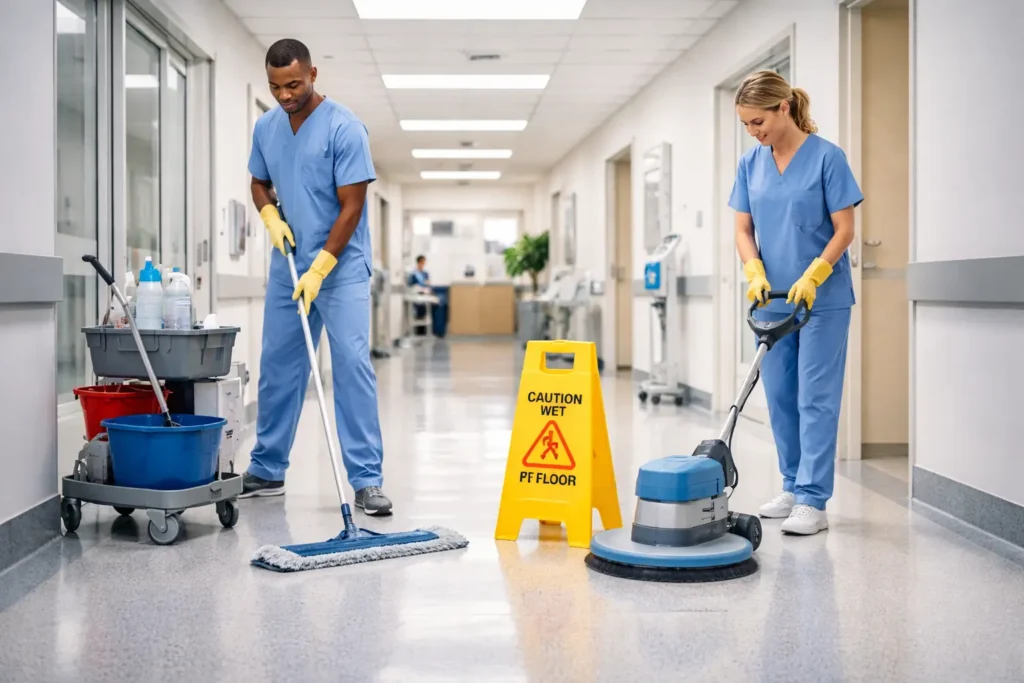
Hospital floors are one of the most critical surfaces in any healthcare setting. They must be spotlessly clean, free from harmful pathogens, and safe for patients, staff, and visitors at all times. A single lapse in floor hygiene can lead to hospital-acquired infections (HAIs) , a serious concern across healthcare facilities in the UAE and worldwide.
Unlike regular commercial cleaning, hospital-grade floor cleaning requires specialized disinfectants that kill bacteria, viruses, fungi, and spores. In this guide, we break down exactly which floor cleaners hospitals use, how they work, and why choosing the right product matters.
Which floor cleaners are used in hospitals?
Hospitals primarily use quaternary ammonium compounds, sodium hypochlorite (bleach), hydrogen peroxide, and phenolic disinfectants. These hospital-grade floor cleaners kill bacteria, viruses, and fungi while meeting strict infection control and safety standards.
Types of Floor Cleaners Used in Hospitals
Not all floor cleaners are created equal. Hospitals in the UAE must use products that meet international infection control standards. Here are the main types used across healthcare environments:
Quaternary Ammonium Compounds (Quats)
Quats are the most commonly used hospital-grade disinfectants for floor cleaning. They are effective against a broad spectrum of bacteria, viruses, and fungi. They are low-toxicity, fast-acting, and leave no strong odor making them ideal for patient areas and high-traffic hospital corridors.
Phenolic Disinfectants
Phenolic-based floor cleaners offer strong germicidal properties and are often used in areas with high infection risk, such as ICUs, isolation wards, and operating theatres. They are effective against mycobacteria including TB organisms.
Hydrogen Peroxide-Based Solutions
Accelerated hydrogen peroxide (AHP) solutions offer hospital-level disinfection with a low environmental impact. These are popular in UAE hospitals committed to green cleaning initiatives. They are safe on most floor surfaces and break down into water and oxygen after use.
Sodium Hypochlorite (Chlorine-Based Cleaners)
Sodium hypochlorite, or bleach-based cleaners, are used for high-risk areas such as isolation rooms, bathrooms, and areas exposed to blood or bodily fluids. They are highly effective against spores like Clostridioides difficile (C. diff) but require careful dilution and handling.
Enzymatic Floor Cleaners
Enzymatic cleaners work by breaking down organic matter such as blood, urine, and other biological substances at a molecular level. They are used as a pre-cleaner before disinfection to ensure the floor surface is fully decontaminated.
Step-by-Step Hospital Floor Cleaning Process
Professional hospital cleaning follows a strict protocol to prevent cross-contamination and ensure infection control compliance, which is why partnering with reliable Floor Cleaning Suppliers in UAE is essential for maintaining high hygiene standards.
Step 1: Remove Visible Debris
Sweep or dry-mop the floor to remove dust, dirt, and loose particles before any wet cleaning begins.
Step 2: Apply Enzymatic Pre-Cleaner
Use an enzymatic cleaner to break down organic material and prepare the surface for disinfection.
Step 3: Apply Hospital-Grade Disinfectant
Apply the appropriate disinfectant floor cleaner based on the ward type using a mop or auto-scrubber. Allow dwell time as per product instructions.
Step 4: Scrub and Agitate
Use a color-coded mop system or floor scrubber to agitate the solution, reaching grout lines and corners.
Step 5: Rinse (if Required)
Some disinfectants require rinsing. Follow the product instructions carefully to avoid chemical residue.
Step 6: Allow to Dry
Ensure floors are completely dry before foot traffic resumes. Use wet floor signs to prevent slips.
Step 7: Document and Verify
Record the cleaning activity. Some UAE hospitals use digital logs or ATP testing to verify cleaning effectiveness.
Benefits of Using the Right Hospital Floor Cleaner
- Reduces Hospital-Acquired Infections (HAIs) significantly
- Meets UAE Ministry of Health and HAAD/DOH regulatory standards
- Protects patients, staff, and visitors from pathogen exposure
- Extends the life of flooring materials like vinyl, epoxy, and tiles
- Supports Joint Commission International (JCI) accreditation requirements
- Improves overall hospital hygiene audit scores
- Enhances patient confidence and satisfaction in the facility
Cost & Pricing Factors for Hospital Floor Cleaning Products in UAE
The cost of hospital-grade floor cleaning solutions in the UAE varies based on several factors:
- Type of disinfectant: Hydrogen peroxide and phenolic products cost more than basic quats
- Concentration level: Ready-to-use (RTU) solutions cost more per litre than concentrated formulas
- Volume purchased: Bulk purchasing for large hospitals reduces per-unit costs significantly
- Brand and certification: EPA, EN 14476, or ISO certified products carry a premium
- Frequency of use: High-traffic wards require more frequent applications
- Supplier location: Local UAE suppliers offer faster delivery and better pricing than imports
Comparison: Hospital Floor Cleaner Types at a Glance
| Cleaner Type | Best For | Kills Spores? | Eco-Friendly? | Common Use |
| Quats | General wards, corridors | No | Moderate | Everyday cleaning |
| Phenolic | ICU, isolation wards | No | Low | High-risk areas |
| Hydrogen Peroxide | All hospital areas | Yes (AHP) | High | Green cleaning |
| Sodium Hypochlorite | Bathrooms, biohazard | Yes | Low | Outbreak response |
| Enzymatic | Pre-cleaning only | No | High | Before disinfection |
Common Mistakes to Avoid in Hospital Floor Cleaning
Using Domestic Cleaners in Clinical Areas
Household floor cleaners do not meet hospital infection control standards and can create a false sense of cleanliness while pathogens survive.
Incorrect Dilution Ratios
Using too little disinfectant reduces efficacy. Using too much wastes product and can damage floor surfaces or irritate occupants.
Skipping Dwell Time
Disinfectants need time to kill pathogens. Mopping and immediately removing the product negates its germicidal effect.
Using the Same Mop Across Multiple Areas
Cross-contamination between wards is a major risk. Color-coded mop systems are essential in all UAE hospitals.
Neglecting Grout Lines and Corners
Pathogens accumulate in floor joints and corners. Auto-scrubbers and detail brushes should be used for thorough coverage.
No Documentation or Audit Trail
Facilities without cleaning logs risk non-compliance with MOH, DOH, or JCI inspection requirements.
Conclusion: Get Hospital-Grade Cleaning Solutions in the UAE
Choosing the right floor cleaner for your hospital or healthcare facility is not just about cleanliness, it is about patient safety, infection control compliance, and regulatory excellence. Whether you need quaternary ammonium compounds for daily ward cleaning, hydrogen peroxide solutions for eco-conscious disinfection, or chlorine-based products for biohazard areas, the right product must match the specific risk level of each zone.
Ready to upgrade your hospital hygiene standards? Kemtech Hygiene Concepts supplies premium, hospital-grade floor cleaning solutions across the UAE. Contact us today for a free consultation, product samples, and bulk pricing trusted by healthcare facilities from Dubai to Abu Dhabi.
Frequently Asked Questions (FAQs)
What is the best floor cleaner for hospitals?
The best hospital floor cleaner depends on the ward type. Quaternary ammonium compounds work well for general areas, while hydrogen peroxide or chlorine-based solutions are better for high-risk and isolation zones.
Are hospital floor cleaners safe for patients?
Yes, when used correctly. Hospital-grade disinfectants are tested for efficacy and safety. Always ensure proper ventilation and allow floors to dry fully before patients or visitors enter the area.
Which floor cleaner kills C. diff spores in hospitals?
Sodium hypochlorite (bleach-based) solutions are the most effective against Clostridioides difficile spores. They must be diluted correctly and used with adequate dwell time per product guidelines.
How often should hospital floors be cleaned?
High-risk hospital areas should be cleaned and disinfected at least twice daily. Corridors, waiting areas, and general wards typically require daily or shift-based cleaning with documented records.
Do UAE hospitals use eco-friendly floor cleaners?
Yes, many UAE hospitals are adopting accelerated hydrogen peroxide (AHP) and other green-certified floor disinfectants as part of their sustainability and infection control strategies.
Do hospitals use disinfectants on floors daily?
Yes, high-traffic areas are disinfected multiple times a day. This reduces cross-contamination and prevents healthcare-associated infections (HAIs).