Passing the Dubai Municipality hygiene inspection is not just about keeping your kitchen tidy. It requires the right professional cleaning chemicals used correctly, at the right concentration, and on the right surfaces.
Many hotels and restaurants in Dubai fail their municipality inspection not because they skip cleaning, but because they use the wrong products. Household cleaners, diluted solutions, or unapproved chemicals simply do not meet the standard.
At Kemtech Hygiene Concepts, we work with hospitality and food service businesses across the UAE to ensure they meet and exceed DM standards. In this guide, we break down every critical area of the checklist and share actionable insights to help your establishment stay audit-ready year-round.
What Does Dubai Municipality Look for During a Hygiene Inspection?
The Dubai Municipality Food Safety Department checks more than just whether your kitchen looks clean. Inspectors verify that the correct cleaning and sanitizing products are being used, stored properly, and applied as per protocol.
Key things inspectors check related to cleaning chemicals:
- Food-safe, approved sanitizers being used on food contact surfaces?
- Chemical storage areas clearly labelled and separated from food?
- Dilution ratios and application instructions being followed?
- Are Material Safety Data Sheets (MSDS) available for all chemicals on-site?
- Are cleaning chemicals stored in original or clearly labelled containers?
If your business cannot answer yes to all of these, you are at risk of a violation.
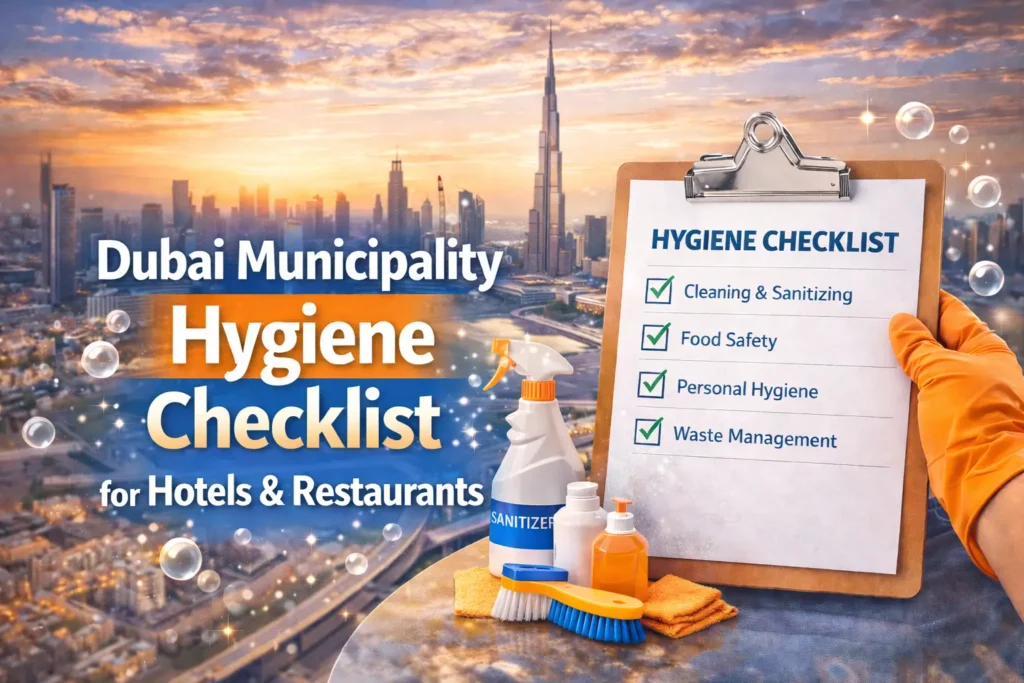
Dubai Municipality Hygiene Checklist: What’s Included
-
Food Safety & Storage
- Maintain correct temperatures (fridge 5°C, freezer -18°C)
- Check expiry dates on all food items
- Keep raw and cooked food completely separate
- Follow FIFO system (First In, First Out)
-
Kitchen & Equipment Hygiene
- All surfaces, cutting boards and utensils must be clean and sanitized
- Grease traps must be regularly cleaned
- No damaged, cracked or rusted equipment allowed
- Maintain a proper cleaning schedule with records
-
Personal Hygiene of Staff
- Every food handler must have a valid DM Food Handler Certificate
- Wearing gloves, hairnet and apron is mandatory
- No sick staff allowed in the kitchen
- Jewelry and nail polish are strictly prohibited
-
Pest Control
- Active pest control contract with a DM-approved company is required
- No signs of cockroaches, rats or flies anywhere on premises
- Bait stations and fly traps must be properly installed
- Pest control service records must be available at all times
-
Washroom Hygiene
- Soap, hand dryer or paper towels must be available in all washrooms
- Washrooms must be clean and odor-free at all times
- Staff toilets must be separate from food preparation areas
- Signed cleaning logs must be maintained
-
Waste Management
- Covered bins must be placed in all kitchen and food prep areas
- Waste must be removed after every shift
- Separate bins for food waste, recyclables and general waste
-
Water Quality
- Potable water must come from a DM-approved source
- Ice machines must be regularly sanitized
- Water filters must be replaced on schedule
-
HACCP Documentation
- A written food safety plan must be in place
- Critical control points must be clearly identified
- All records and corrective actions must be properly documented
-
Food Handler Training Records
- Staff certificates must be valid and up to date
- Training records must be maintained for all staff
- New employees must be trained immediately upon joining
-
Labeling & Traceability
- Every food item must be clearly date-labeled
- Supplier records must be available for inspection
- Allergen information must be clearly displayed
These are the 10 main areas a DM inspector checks during every visit. A gap in any single area can result in a fine, warning, or temporary closure.
Cleaning Chemicals to Pass Dubai Municipality Inspection
Using the right food safe cleaning chemicals is one of the most critical steps to passing a Dubai Municipality inspection without violations.
Follow these storage rules to stay compliant:
- Separate storage: Cleaning chemicals must never be stored near food, utensils, or packaging
- Labelling: Every chemical container must be clearly labelled with the product name and hazard information
- MSDS availability: Material Safety Data Sheets must be on-site for every chemical product used
- Original containers: Never transfer chemicals into unmarked or food containers
- Locked storage: Certain concentrated chemicals must be stored in locked, ventilated cabinets
- Dilution instructions: Mixing ratios must be clearly displayed and followed by all cleaning staff
Conclusion: The Right Chemicals Make the Difference
Passing the Dubai Municipality hygiene inspection comes down to using the right cleaning chemicals. The wrong products, improper storage, or missing documentation can cost your business thousands in fines or even a forced closure.
Kemtech Hygiene Concepts supplies the exact cleaning chemicals your hotel or restaurant needs, backed by full documentation and expert support. Contact us today and make your next municipality inspection one less thing to worry about.
Frequently Asked Questions (FAQs)
What cleaning chemicals are required to pass the Dubai Municipality hygiene inspection?
You need food-safe sanitizers, kitchen degreasers, floor cleaners, drain cleaners, and antibacterial hand soap as a minimum. All products must have MSDS documentation available on-site during the inspection.
Can I use regular household cleaners in my restaurant kitchen in Dubai?
Household cleaners do not meet the concentration or efficacy standards required by Dubai Municipality. Commercial-grade, food-safe cleaning chemicals are mandatory for all licensed food establishments in the UAE.
Do I need to keep records of cleaning chemical usage?
Dubai Municipality inspectors may ask for cleaning schedules and logs showing how often deep cleaning is performed. Having MSDS sheets and usage instructions on-site is also a compliance requirement.
How should cleaning chemicals be stored in a restaurant or hotel kitchen?
Chemicals must be stored in a separate, clearly labelled, and ventilated area away from all food, utensils, and packaging. All containers must be labelled, and MSDS sheets must be accessible to staff at all times.
How often should deep cleaning chemicals be used in a commercial kitchen?
Daily sanitizing of food contact surfaces is required. Full deep cleaning of grease traps, exhaust hoods, and drains should be done weekly or monthly depending on usage volume and your HACCP cleaning schedule.
Does Kemtech Hygiene Concepts supply cleaning chemical to restaurants & hotels?
Kemtech Hygiene Concepts supplies professional cleaning chemicals to all sizes of food establishments across the UAE from small cafes and cloud kitchens to five-star hotels and large catering operations.