

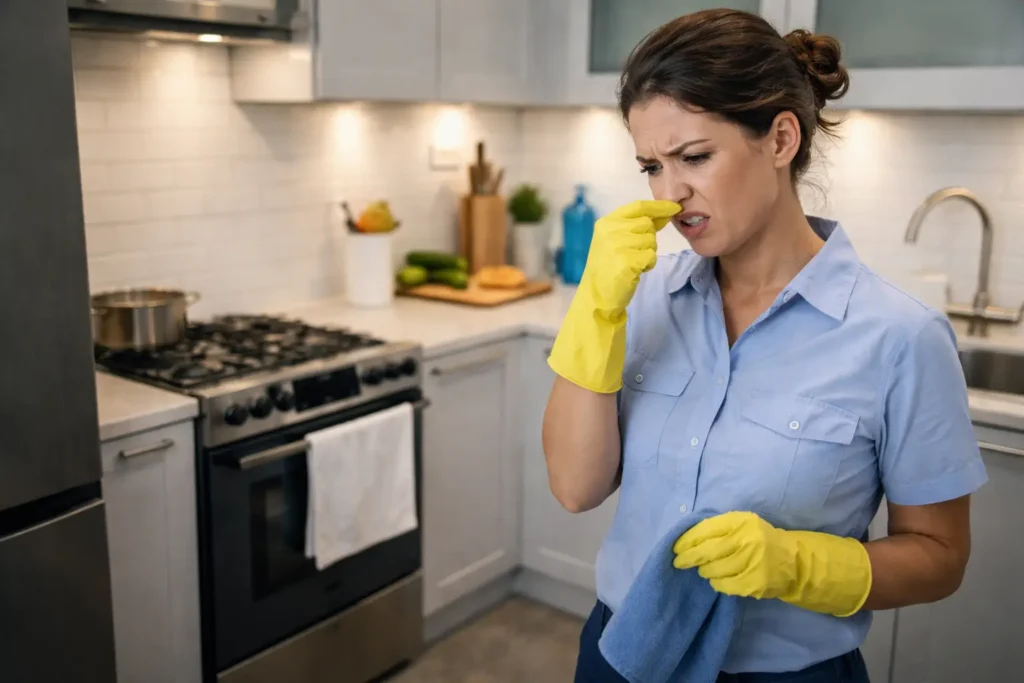
Your kitchen still smells after cleaning in Dubai because standard cleaning products remove visible dirt but fail to eliminate the root causes of odour hidden grease buildup, bacterial biofilm in drains, moisture trapped under appliances, and inadequate ventilation. Dubai’s high humidity and heat accelerate bacterial growth and grease oxidation, making post-clean odours significantly worse than in cooler climates.
Quick Answer
- Clean hidden grease deposits behind appliances and inside exhaust filters.
- Disinfect floor drains and sink drains with an enzyme-based drain cleaner.
- Use an odour-neutralising disinfectant, not just a surface cleaner.
- Improve kitchen ventilation check and clean exhaust fans monthly.
- Dry all surfaces completely after cleaning to stop bacterial regrowth.
- Replace old mops and sponges that harbour odour-causing bacteria.
- Deep clean kitchen floors, walls, and grout lines at least once weekly.
Why Your Kitchen Still Smells After Cleaning?
A kitchen that smells after cleaning is a sign that surface-level cleaning has occurred but the odour source has not been eliminated. In Dubai’s climate average temperatures of 35-45°C in summer and humidity levels above 60% bacteria multiply up to 3x faster than in temperate climates. This makes odour sources harder to control and quicker to return after a basic clean.
The five most common reasons a kitchen still smells after cleaning are:
- Grease trapped in exhaust filters and hood vents: oxidises in heat and produces a rancid, persistent smell
- Bacterial biofilm in floor drains and sink traps: releases hydrogen sulphide gas, which smells like rotten eggs
- Food residue under and behind appliances: decomposes rapidly in Dubai’s heat
- Damp mops, cloths, and sponges: reintroduce bacteria onto surfaces during cleaning
- Wrong cleaning products: general-purpose cleaners mask odours rather than neutralise them at a molecular level
Kitchen Smell After Cleaning Checklist
| Odour Source | Root Cause | Fix | Frequency |
| Drains and sink traps | Bacterial biofilm, food buildup | Enzyme drain cleaner | Weekly |
| Exhaust hood and filters | Oxidised grease | Alkaline degreaser soak | Monthly |
| Floor grout lines | Trapped organic matter | Steam clean or acid descaler | Weekly |
| Behind and under appliances | Decomposing food debris | Full deep clean | Monthly |
| Mops and cleaning cloths | Bacterial contamination | Replace or sanitise after every use | Daily |
| Walls and tile splashbacks | Grease film | Alkaline degreaser spray | Weekly |
What You Need Before You Start
Gather these products and tools before beginning an odour-elimination deep clean. Using the correct products is the single biggest factor in permanently removing kitchen smells after cleaning.
- Alkaline degreaser: (pH 9-11) for exhaust hoods, filters, walls, and tile surfaces
- Enzyme-based drain cleaner: enzymes digest organic matter and biofilm inside drain pipes
- Odour-neutralising disinfectant: containing quaternary ammonium compounds (quats) or hydrogen peroxide
- Baking soda (sodium bicarbonate): absorbs and neutralises acidic odour molecules on contact
- White vinegar or citric acid solution: for descaling drain grates and removing mineral odour deposits
- Microfibre cloths: colour-coded to prevent cross-contamination between zones
- Stiff grout brush: for scrubbing floor grout lines and drain channels
- PPE: rubber gloves, eye protection, and a face mask when using concentrated degreasers
- Bucket and dosing pump: for accurate chemical dilution
Why Your Kitchen Still Smells After Cleaning: Tips
Follow these 7 steps in order to permanently eliminate kitchen odours in Dubai. Skipping steps particularly drain treatment and appliance deep cleaning allows odour sources to remain active.
Step 1: Identify All Odour Sources Before Cleaning
Inspect the kitchen systematically before applying any product. Check floor drains, sink P-traps, exhaust filters, the back and underside of cooking equipment, grout lines, and waste bins. Identifying every odour source at the start ensures no area is missed. In Dubai restaurant kitchens, floor drains and exhaust hoods are responsible for over 70% of persistent post-clean odours.
Step 2: Deep Clean the Exhaust Hood and Grease Filters
Remove grease filters from the exhaust hood and submerge them in a hot alkaline degreaser solution (1 part degreaser to 10 parts water at 50°C) for 20-30 minutes. Scrub with a stiff brush, rinse thoroughly, and allow to dry fully before reinstalling. Wipe the interior of the exhaust hood canopy with undiluted alkaline degreaser applied via a microfibre cloth. Oxidised grease inside exhaust hoods is the leading cause of persistent cooking smells in Dubai kitchens.
Step 3: Treat Floor Drains and Sink Traps with Enzyme Cleaner
Pour 500ml of enzyme-based drain cleaner directly into each floor drain and sink trap. Allowing a minimum 15-minute dwell time overnight treatment delivers better results on heavily blocked drains. Enzyme cleaners digest the bacterial biofilm that coats drain pipe interiors and produces hydrogen sulphide gas. Do not rinse the enzyme cleaner out to allow it to work through the drain naturally. Treat all drains once weekly to prevent biofilm reformation.
Step 4: Clean Grout Lines and Floor Channels
Apply an alkaline floor cleaner directly to grout lines and floor channel drains. Scrub with a stiff grout brush using circular motions to lift embedded organic matter. Rinse with hot water and follow with an acid descaler (pH 2-4) on drain grates to dissolve mineral deposits that trap odour. Grout lines in commercial kitchen floors trap fat, protein, and moisture, three conditions that produce odour rapidly in Dubai’s heat.
Step 5: Clean Behind and Under All Appliances
Pull out fridges, cooking ranges, prep tables, and under-counter units. Remove all food debris, grease spillage, and moisture using an alkaline degreaser applied with a microfibre cloth. Pay particular attention to rubber door seals on refrigerators bacterial growth inside seals produces a strong musty odour. Wipe all surfaces dry immediately after cleaning to prevent moisture-driven bacterial regrowth.
Step 6: Disinfect All Surfaces with an Odour-Neutralising Product
Apply a quat-based odour-neutralising disinfectant to all cleaned surfaces floors, walls, appliance exteriors, and prep surfaces. Quaternary ammonium compounds kill odour-causing bacteria including Pseudomonas, E. coli, and Staphylococcus at a 99.9% kill rate within 60 seconds of contact. Allow surfaces to air-dry fully. Do not wipe off the disinfectant. The residual film continues working for 4-6 hours post-application.
Step 7: Improve Ventilation and Dispose of Contaminated Cleaning Tools
Run the exhaust fan for 30 minutes after cleaning to remove airborne odour particles and reduce humidity. Replace any mops, sponges, or cloths used in this session, do not reuse them without sanitising in a 1:100 bleach solution and fully air-drying. Dispose of waste bin liners immediately and clean bin interiors with disinfectant. Install a carbon filter or air purifier rated for kitchen environments if odours persist beyond 24 hours after a full deep clean.
How Long Does It Take to Eliminate Kitchen Odours After Cleaning?
Odour elimination time depends on severity and the number of active odour sources:
- Light odour (recent buildup): 45-60 minutes using the full 7-step process
- Moderate odour (1-2 weeks of missed deep cleaning): 90-120 minutes
- Severe odour (chronic grease and drain buildup): 2-3 hours; may require a second treatment 24 hours later
- Drain biofilm treatment: Overnight enzyme treatment for best results on heavily affected drains
How Often Should You Deep Clean to Prevent Kitchen Smells?
In Dubai’s climate, standard cleaning frequency is not sufficient to prevent odour. Follow this schedule:
- Daily: Sanitise surfaces, replace mops and cloths, clean waste bins, wipe appliance exteriors
- Every 2-3 days: Clean floor drains with enzyme cleaner, degrease cooking surfaces
- Weekly: Deep clean grout lines, treat all drains, degrease walls and splashbacks
- Monthly: Full exhaust hood and filter deep clean, clean behind all appliances, inspect refrigerator seals
- Quarterly: Full HACCP deep clean audit; reassess ventilation performance and chemical products
Conclusion
A kitchen that still smells after cleaning in Dubai is almost always the result of missed odour sources particularly grease-saturated exhaust filters, biofilm-coated drains, and food debris trapped under appliances. Switching from general-purpose cleaners to targeted products including alkaline degreasers, enzyme drain cleaners, and quat-based odour-neutralising disinfectants eliminates odours at the source rather than masking them.
For professional-grade Kitchen Cleaning Chemicals in Dubai including enzyme drain cleaners, HACCP-approved degreasers, and odour-neutralising disinfectants contact Kemtech Hygiene Concepts, trusted by hotels, restaurants, and catering facilities across the UAE.
Frequently Asked Questions
What is the fastest way to get rid of kitchen smell after cleaning?
The fastest way to eliminate kitchen smell after cleaning is to treat floor drains with an enzyme-based drain cleaner and apply a quat-based odour-neutralising disinfectant to all surfaces. This combination eliminates the bacterial source of odour within 15-30 minutes.
Can I eliminate kitchen odours in one cleaning session?
You can eliminate kitchen odours in one session by following a 7-step deep clean covering drains, exhaust filters, appliance undersides, grout lines, and surfaces. Severe biofilm buildup in drains may require a second enzyme treatment after 24 hours.
What is the best product to remove kitchen smell after cleaning in Dubai?
The best products to remove kitchen smell after cleaning in Dubai are enzyme-based drain cleaners for drain odours and quaternary ammonium odour-neutralising disinfectants for surface odours. Alkaline degreasers (pH 9-11) remove the oxidised grease that causes rancid cooking smells.
Why does my kitchen smell worse in summer in Dubai?
A kitchen smells worse in summer in Dubai because temperatures above 40°C accelerate bacterial growth and grease oxidation by up to 3x compared to cooler conditions. High humidity above 60% also slows surface drying, giving bacteria more time to multiply and produce odour compounds.
What should I do first if my kitchen smells after cleaning?
The first step when a kitchen still smells after cleaning is to inspect and treat all floor drains and sink traps with an enzyme-based drain cleaner. Drains are responsible for over 70% of persistent kitchen odours in commercial kitchens and are the most commonly overlooked area during routine cleaning.