

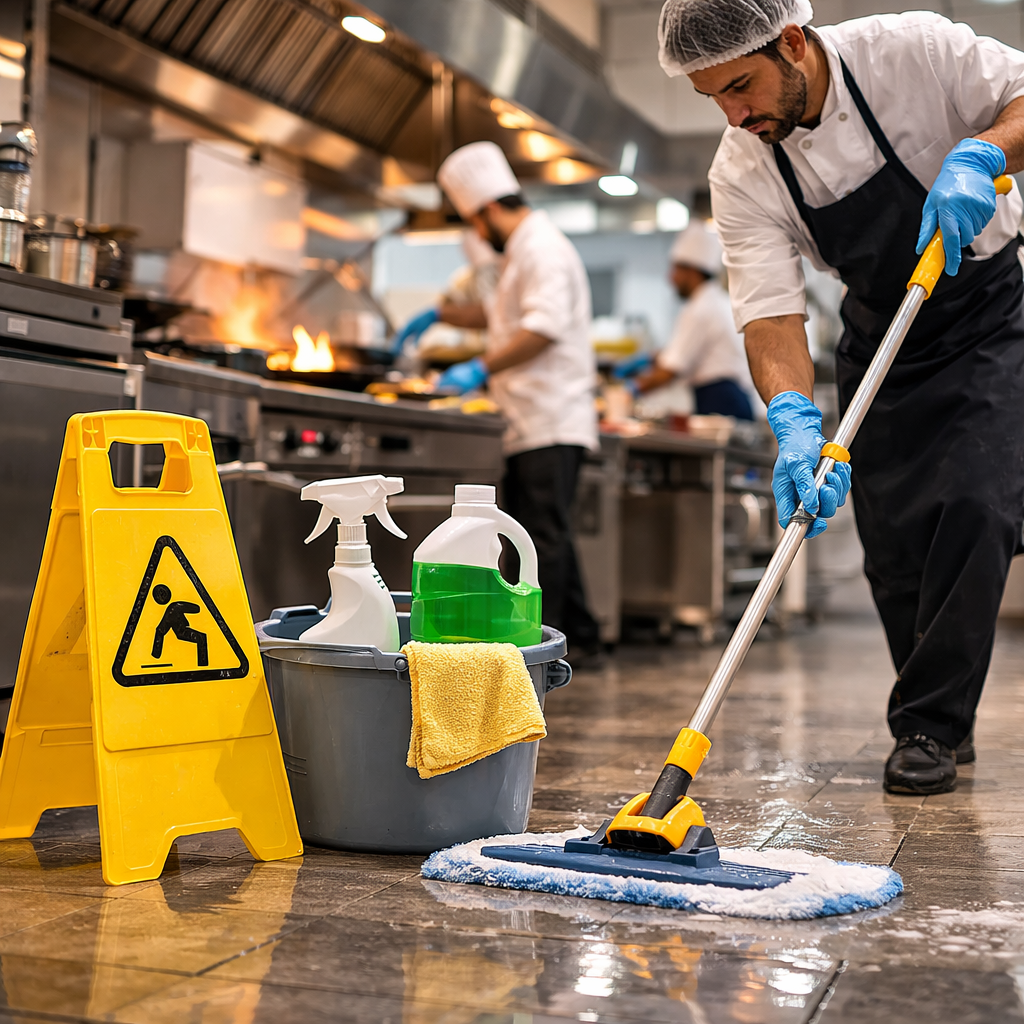
The safest floor cleaner for Dubai restaurant kitchens is a food-safe, non-slip, HACCP-compliant degreaser formulated for commercial kitchen use. Products such as quaternary ammonium-based neutral cleaners and alkaline degreasers rated for food contact zones meet Dubai Municipality hygiene regulations and eliminate grease, bacteria, and biofilm without leaving toxic residues. Always verify that the product carries a food-safe certification and is approved for use in catering environments before application.
Quick Answer
- Choose a HACCP-certified, food-safe alkaline degreaser for kitchen floors.
- Verify the product meets Dubai Municipality food premises standards.
- Diluting correctly improper dilution reduces safety and effectiveness.
- Apply a non-slip treatment after cleaning to prevent accidents.
- Deep-clean kitchen floors at least once daily in high-volume kitchens.
- Store cleaning chemicals in a separate, labelled area away from food.
- Train all kitchen staff on correct product usage and PPE requirements.
Safe Floor Cleaner for Restaurant & Kitchens
A safe floor cleaner for a restaurant kitchen is a chemical formulation that removes grease, oils, food debris, and pathogenic bacteria from kitchen floor surfaces without posing contamination risks to food, staff, or customers. In Dubai, restaurant kitchens must comply with Dubai Municipality Food Safety Department guidelines (Regulation No. 11 of 2003 and subsequent updates), which mandate the use of food-safe, non-toxic cleaning chemicals in food preparation areas.
Three categories of cleaners are approved for commercial kitchen floor use:
- Alkaline degreasers (pH 9–13): Break down animal fats, vegetable oils, and protein residues. Ideal for heavy-duty daily cleaning in high-volume kitchens.
- Neutral cleaners (pH 6.5–8): Suitable for light maintenance cleaning between service periods. Safe on most tile, concrete, and epoxy floor surfaces.
- Quaternary ammonium (quat) disinfectant cleaners: Combine degreasing action with bactericidal properties. Approved for food contact surface use when correctly diluted.
Floor Cleaner Safety at a Glance
| Task | Method | Frequency | Time Needed |
| Daily deep clean | Alkaline degreaser + deck brush + rinse | Once daily (end of service) | 20–35 min |
| Between-service wipe-down | Neutral cleaner + microfibre mop | Every 2–4 hours | 5–10 min |
| Disinfection | Quat-based disinfectant cleaner | After daily clean | 10–15 min |
| Grout & drain cleaning | Acidic descaler (pH 2–4) | Weekly | 15–20 min |
| Non-slip treatment | Anti-slip floor coating solution | Monthly or as needed | 30–45 min |
Recommended Floor Cleaner Products for Dubai Restaurant Kitchens
The following product types meet food safety requirements and are commonly used in Dubai’s commercial kitchen sector. Always request the Safety Data Sheet (SDS) and Technical Data Sheet (TDS) before purchasing any cleaning chemical.
| Product Type | pH Range | Best For | Dubai Compliance |
| Alkaline degreaser floor cleaner | 9–11 | Heavy grease, end-of-day deep clean | HACCP Compliant |
| Neutral pH floor cleaner | 6.5–8 | Maintenance cleaning, delicate floors | Food Safe |
| Quat disinfectant cleaner | 7–9 | Combined clean + disinfect | Bactericidal |
| Enzyme-based floor cleaner | 7–8 | Organic waste, drain odours | Eco-Friendly |
| Acidic descaler | 2–4 | Mineral deposits, grout lines, drains | Weekly Use Only |
What You Need Before You Start
Gather the following equipment and supplies before beginning a kitchen floor cleaning session. Using the right tools including professionally formulated Floor Cleaners in Dubai suited for commercial kitchen environments reduces cleaning time by up to 40% and prevents cross-contamination between zones.
- HACCP-approved alkaline floor degreaser: (dilute per label: typically 1:10 to 1:20 with water)
- Quat-based disinfectant cleaner: for post-clean sanitisation
- Colour-coded mops and buckets: red for toilets, green for kitchen floors (Dubai food safety standard)
- Stiff deck brush or auto-scrubber: for tile grout and heavy soiling
- Wet floor warning signs: (mandatory under UAE Occupational Health and Safety Law)
- Personal Protective Equipment (PPE): rubber gloves, non-slip boots, protective eyewear
- Measuring jug or dosing pump: for accurate chemical dilution
- Floor squeegee: for efficient water removal and faster drying
Never mix an alkaline degreaser with an acidic descaler in the same bucket. The chemical reaction neutralises both products and produces harmful fumes. Always use separate, labelled containers.
Safest Floor Cleaner for Dubai Restaurant Kitchens: Checklist
Follow this 7-step process to clean kitchen floors safely, comply with Dubai Municipality food safety regulations, and maintain a slip-free working environment.
Step 1: Clear the Floor Area
Remove all portable equipment, mats, and obstacles from the floor zone. Move floor-standing appliances if safe to do so. This exposes 100% of the floor surface and prevents chemical pooling under equipment, which creates slip hazards and bacterial hotspots.
Step 2: Sweep or Vacuum Dry Debris
Use a stiff broom or industrial vacuum to remove all dry food debris, dust, and solid waste. Applying a wet degreaser over solid debris reduces its effectiveness and blocks drains. Dispose of debris directly into a covered waste bin never sweeps toward food preparation areas.
Step 3: Dilute Your Floor Degreaser Correctly
Fill a clean mop bucket with warm water (40–50°C for optimal degreasing). Add your alkaline floor degreaser at the manufacturer-recommended dilution rate typically 50–100ml per 10 litres of water. Use a measuring jug or dosing pump for accuracy. Over-concentration wastes product and increases residue risk; under-concentration leaves grease behind.
Regulatory Note: Dubai Municipality inspectors check that chemicals are stored in original containers with visible labels. Never decant concentrated chemicals into unlabelled containers.
Step 4: Apply Degreaser and Agitate
Mop the degreaser solution onto the floor working from the back of the kitchen toward the exit this prevents staff walking over wet areas. Allow a 3–5 minute dwell time for the degreaser to penetrate grease deposits. Use a stiff deck brush to scrub grout lines, floor junctions, and corners where grease accumulates. An automatic floor scrubber reduces labour time by 60% on large kitchen floors.
Step 5: Rinse Thoroughly with Clean Water
Use fresh clean water (no cleaning chemical) to rinse the entire floor. Residual alkaline cleaner on kitchen floors creates a slippery surface and may transfer to food if not removed. Use a floor squeegee to push rinse water toward floor drains. Repeat rinsing if any foam or slippery film remains.
Step 6: Apply Disinfectant (Post-Clean Sanitisation)
After rinsing, apply a diluted quaternary ammonium disinfectant cleaner using a fresh mop. This step eliminates residual bacteria including Salmonella, E. coli, and Listeria monocytogenes from floor surfaces. Allow the disinfectant to air-dry and do not rinse off quat-based disinfectants as this removes their residual bactericidal action.
Step 7: Post-Clean Safety Check and Record Keeping
Verify the floor is dry and free of chemical residue before allowing staff or customers into the area. Remove wet floor signs only once the surface is fully dry. Record the cleaning activity in your HACCP cleaning log including the date, time, product used, dilution rate, and staff member responsible. Dubai Municipality food safety audits require these records to be available for inspection at all times.
How Long Does Kitchen Floor Cleaning Take?
Cleaning time depends on floor area, soil level, and equipment used:
- Small kitchen (under 30 m²): 20–25 minutes for a full clean using manual mops
- Medium kitchen (30–80 m²): 30–45 minutes manually; 15–20 minutes with an auto-scrubber
- Large commercial kitchen (80 m²+): 45–60 minutes manually; 25–35 minutes with automated equipment
- Quick between-service mop-down: 5–10 minutes for neutraliser application and squeegee
How Often Should You Clean Restaurant Kitchen Floors?
Dubai Municipality mandates that commercial kitchen floors are cleaned and sanitised at a frequency that prevents contamination. The recommended schedule:
- Every 2–4 hours: Spot clean spills using a neutral cleaner; remove slip hazards immediately
- Daily (end of service): Full alkaline degreaser clean + quat disinfection
- Weekly: Acidic descaler treatment for grout lines, floor drains, and channel drains
- Monthly: Deep clean including moving heavy equipment; reapply anti-slip floor treatment
- Quarterly: Full HACCP cleaning audit; review chemical dilution rates and update cleaning schedule
Dubai Inspection Tip: Dubai Municipality Food Safety Department inspectors can conduct unannounced visits. A kitchen with up-to-date HACCP cleaning records, correctly labelled chemicals, and a colour-coded cleaning system is significantly less likely to receive enforcement action.
Conclusion
The safest floor cleaner for Dubai restaurant kitchens combines a food-safe alkaline degreaser for daily deep cleaning with a quaternary ammonium disinfectant for post-clean sanitisation. Selecting the right product, diluting it correctly, and following a structured step-by-step cleaning process protects staff from slip hazards, prevents cross-contamination, and keeps your kitchen compliant with Dubai Municipality food safety regulations.
For a full range of Dubai-approved Kitchen Cleaning Chemicals in Dubai, contact Kemtech Hygiene Concepts trusted by leading hotels, restaurants, and catering companies across the UAE.
Frequently Asked Questions
What is the fastest method to clean a restaurant kitchen floor in Dubai?
The fastest method to clean a restaurant kitchen floor is to use an automatic floor scrubber loaded with a diluted alkaline degreaser. This approach reduces manual cleaning time by up to 60% compared to mop-and-bucket methods and delivers a consistent, HACCP-compliant clean on floors over 30 m².
Can I clean and disinfect a kitchen floor in one session?
You can clean and disinfect a kitchen floor in one session by using a quat-based combined cleaner-disinfectant on lightly soiled floors. For heavily greased floors, a two-stage approach alkaline degreaser first, then disinfectant delivers better results and meets Dubai Municipality standards.
What is the best floor cleaning product approved for Dubai restaurant kitchens?
The best floor cleaning products for Dubai restaurant kitchens are HACCP-certified alkaline degreasers (pH 9–11) for daily cleaning and quaternary ammonium disinfectants for sanitisation. Always request a Safety Data Sheet (SDS) and confirm the product is approved for use in food premises before purchasing.
What is the most common kitchen floor cleaning mistake in restaurant kitchens?
The most common kitchen floor cleaning mistake is insufficient rinsing after degreaser application. Alkaline residue left on tile floors creates a persistent slip hazard and attracts more soiling faster. Always rinse with clean water until no foam or slippery film remains before applying disinfectant.
What should you do first when cleaning a restaurant kitchen floor?
The first step when cleaning a restaurant kitchen floor is to remove all dry debris by sweeping or vacuuming before applying any liquid cleaner. Applying a degreaser over solid food debris reduces chemical effectiveness, blocks drain outlets, and risks spreading contamination across the floor surface.