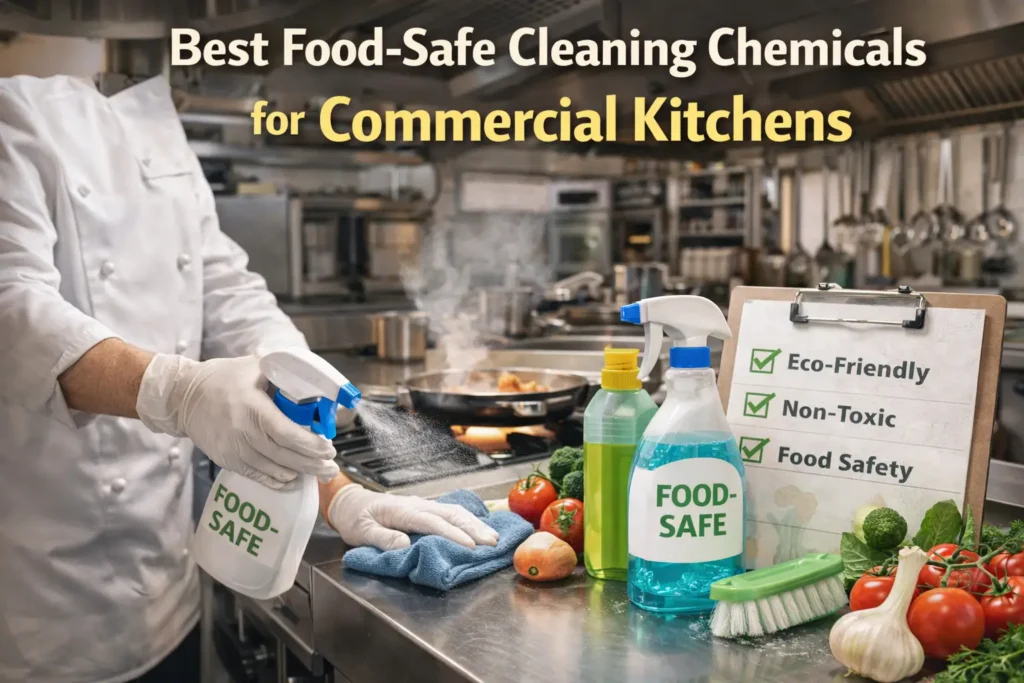
The best food-safe cleaning chemicals for commercial kitchens in UAE include chlorine-based sanitisers, quaternary ammonium compounds (QACs), iodophor sanitisers, hydrogen peroxide cleaners, and alkaline degreasers. These products meet UAE food safety regulations under ESMA standards and are approved for use on food-contact surfaces. Choosing the right chemical depends on the surface type, soil load, and required contact time typically 30 seconds to 2 minutes for effective sanitisation.
- Choose ESMA-approved, food-safe chemicals that match your surface type.
- Use chlorine sanitisers (200 ppm) for general food-contact surfaces.
- Apply QACs for hard, non-porous surfaces requiring residual protection.
- Use alkaline degreasers on grills, fryers, and heavily soiled equipment.
- Always rinse food-contact surfaces thoroughly after applying any chemical.
- Following correct dilution ratios under-dilution fails to sanitise, over-dilution causes residue.
- Train kitchen staff on safe chemical handling and PPE requirements.
What Are Food-Safe Cleaning Chemicals for Commercial Kitchens?
Food-safe cleaning chemicals are agents formulated to remove grease, food residue, bacteria, and pathogens from kitchen surfaces without leaving harmful residues on food-contact areas. In UAE commercial kitchens including restaurants, hotels, hospitals, and catering facilities these chemicals must comply with the Emirates Authority for Standardisation and Metrology (ESMA) guidelines and Dubai Municipality food safety standards.
There are two core functions these products perform:
- Cleaning: removes visible soils, grease, and food debris using detergents or degreasers.
- Sanitising: reduces microbial load on surfaces to a safe level using sanitisers or disinfectants.
Both steps are required in a proper kitchen hygiene protocol. Cleaning without sanitising leaves pathogens on surfaces. Sanitising without cleaning first reduces the sanitiser’s effectiveness.
Food-Safe Cleaning Chemicals List:
| Chemical Type | Best Use | Frequency | Contact Time |
| Chlorine Sanitiser | Food-contact surfaces, cutting boards | After each use | 30–60 seconds |
| QACs | Floors, walls, non-food surfaces | Daily / per shift | 1–2 minutes |
| Alkaline Degreaser | Grills, fryers, ovens, hoods | Daily | 5–10 minutes |
| Iodophor Sanitiser | Small equipment, prep surfaces | After cleaning | 30 seconds |
| Hydrogen Peroxide Cleaner | Delicate surfaces, eco-sensitive zones | As needed | 1–5 minutes |
| Acid Descaler | Dishwashers, steamers, tea urns | Weekly | 10–20 minutes |
What You Need Before You Start
Before applying any food-safe cleaning chemical in a UAE commercial kitchen, gather the following:
- PPE: Chemical-resistant gloves, safety goggles, and closed-toe shoes.
- Dilution tools: Measuring cups, chemical dosing pumps, or pre-dosed pouches.
- Application equipment: Spray bottles, mop buckets, scrub pads, and microfibre cloths.
- Safety data sheets (SDS): Obtain from your chemical supplier — required by UAE Occupational Safety law.
- Product approvals: Verify the product carries ESMA or Dubai Municipality food safety approval.
- Water temperature: Most sanitisers work best between 24°C and 49°C.
Important: Never mix chlorine-based sanitisers with acid-based cleaners. This combination releases toxic chlorine gas and is a serious health hazard in enclosed kitchen spaces.
Food-Safe Cleaning Chemicals for Commercial Kitchens Process
Identify Surface Type and Soil Level
Different surfaces require different chemical strengths. Stainless steel prep tables need a neutral cleaner or mild alkaline degreaser. Tiled floors require a stronger alkaline floor cleaner. Heavily soiled fryers and grills need a concentrated alkaline degreaser with a pH above 11.
Assess the soil level first: light food residue needs a standard multi-surface cleaner; burnt-on grease and carbon deposits require heavy-duty degreasers.
Select the Correct Food-Safe Chemical
- Chlorine sanitisers (sodium hypochlorite): Use at 100–200 ppm for food-contact surfaces. Effective against bacteria, viruses, and moulds. Cost-effective and widely available across UAE suppliers.
- Quaternary ammonium compounds (QACs): Apply at 200 ppm. Ideal for no-rinse applications on walls, drains, and hard surfaces. Leaves a residual antimicrobial film.
- Alkaline degreasers: Use on ovens, fryers, and range hoods. Dilute typically 1:10 to 1:30 with water. Apply, allow 5–10 minutes dwell time, then scrub and rinse.
- Iodophor sanitisers: Use at 12.5–25 ppm iodine concentration. The amber colour indicates active concentration.
- Hydrogen peroxide cleaners: Use 0.5–3% concentration. Eco-friendly, breaks down into water and oxygen. Suitable for halal-certified kitchens.
- Acid descalers (phosphoric or citric acid-based): Use weekly on dishwashers and steamers to remove limescale — critical in UAE due to high mineral content in tap water.
Prepare the Correct Dilution
Incorrect dilution is the most common error in commercial kitchen cleaning. Follow this process:
- Read the manufacturer’s SDS for the correct dilution ratio.
- Use a calibrated dosing pump or measuring cup – never estimate by eye.
- Add chemical to water (not water to chemical) to control foaming.
- Check concentration using test strips where available, especially for chlorine sanitisers.
- Discard solutions after 4 hours or when visibly soiled.
Apply the Chemical Correctly
- Spray application: Hold bottle 20–30 cm from the surface. Use overlapping strokes for full coverage.
- Soak or flood method: Submerge equipment in degreaser solution for the recommended dwell time.
- Mop application: Apply from the furthest point toward the exit to avoid walking on cleaned areas.
- Foam application: Use foam-generating degreasers on vertical surfaces to extend dwell time and prevent run-off.
Allow Correct Dwell Time
- Chlorine sanitiser (200 ppm): 30–60 seconds.
- QACs (200 ppm): 60–120 seconds.
- Alkaline degreaser: 5–10 minutes on hot grills; 3–5 minutes on cooled equipment.
- Iodophor sanitiser: 30 seconds minimum.
- Acid descaler: 10–20 minutes on lime-scaled equipment.
Rinse and Dry Food-Contact Surfaces
Rinse all food-contact surfaces with clean potable water after applying any chemical, except where the product label states it is “no-rinse approved.” QACs at 200 ppm are typically no-rinse approved under UAE standards, but chlorine sanitisers must always be rinsed from food-contact surfaces.
Dry using single-use paper towels or clean, dedicated microfibre cloths.
Verify Cleanliness
- Visual inspection: No visible food residue, grease streaks, or water marks.
- ATP bioluminescence testing: Readings below 10 RLU indicate acceptable cleanliness for food-contact surfaces.
- pH test strips: Confirm rinse water pH is neutral (6.5–7.5) after using acid or alkaline chemicals.
- Chemical test strips: Verify sanitiser concentration is within effective range.
How Long Does Cleaning a Commercial Kitchen Take?
A full end-of-day deep clean for a mid-size UAE commercial kitchen takes 2–3 hours with trained staff. A between-service clean targeting food-contact surfaces and cooking equipment takes 30–45 minutes. A weekly deep clean including descaling, oven interior cleaning, and drain sanitisation takes 4–6 hours.
How Often Should You Clean a Commercial Kitchen in the UAE?
| Task | Chemical to Use | Frequency |
| Food-contact surfaces | Chlorine sanitiser 200 ppm | After every use |
| Cutting boards | Chlorine sanitiser or QAC | After each task |
| Floors | Alkaline floor cleaner + QAC | Every shift |
| Fryers and grills | Alkaline degreaser | Daily |
| Oven interiors | Heavy-duty alkaline degreaser | Daily / Weekly |
| Dishwashers and steamers | Acid descaler | Weekly |
| Cold rooms and fridges | Neutral cleaner + QAC | Weekly |
| Grease traps | Biological drain cleaner | Weekly |
Conclusion
Selecting the best food-safe cleaning chemicals for commercial kitchens in UAE depends on the surface, soil type, contact time available, and the regulatory standard you must meet. Chlorine sanitisers remain the most cost-effective choice for food-contact surfaces. QACs offer convenience and residual protection. Alkaline degreasers tackle heavy-duty grease on cooking equipment. Acid descalers are essential in UAE where hard water accelerates limescale build-up.
For professional-grade Kitchen Cleaners in UAE, Kemtech Hygiene Concepts delivers ESMA-compliant, food-safe cleaning solutions across Dubai, Abu Dhabi, Sharjah, and all seven Emirates with a full range of sanitisers, degreasers, descalers, and multi-purpose cleaners formulated for UAE’s climate and regulatory environment.
Frequently Asked Questions (FAQ)
What is the fastest method for sanitising food-contact surfaces in a UAE commercial kitchen?
The fastest method is a chlorine sanitiser spray at 200 ppm with a 30-second dwell time. Pre-mixed spray bottles allow staff to clean and sanitise a prep surface in under 2 minutes. This method meets Dubai Municipality food safety standards and requires no special equipment.
Can I clean the entire kitchen in one session using a single product?
A multi-purpose alkaline cleaner at pH 9–11 handles most surfaces including countertops, equipment exteriors, and tiled walls. However, stainless steel, glass, and descaling tasks each require purpose-specific chemicals for full effectiveness and to avoid surface damage.
What are the best cleaning products for commercial kitchens in UAE?
The best products include chlorine sanitisers (200 ppm) for food-contact surfaces, concentrated alkaline degreasers (pH 12–13) for grills and fryers, QAC sanitisers for no-rinse floor and wall applications, and acid-based descalers for dishwashers and steamers. All must carry ESMA approval. Kemtech Hygiene Concepts supplies all these categories with full SDS documentation.
What is the most common challenge when using food-safe chemicals in commercial kitchens?
Incorrect dilution is the most common challenge. Staff either over-dilute (reducing efficacy) or under-dilute (leaving residues and increasing costs). Installing calibrated dosing pumps and using colour-coded, pre-labelled spray bottles for each product type solves this effectively.
What should I do first when setting up a cleaning chemical programme for a new UAE commercial kitchen?
First, obtain a cleaning schedule approved by Dubai Municipality or your emirate’s food safety authority. Then contact a licensed supplier like Kemtech Hygiene Concepts for a site survey and ESMA-compliant product recommendations. Ensure all products come with Arabic and English SDS documentation, as required by UAE law.