

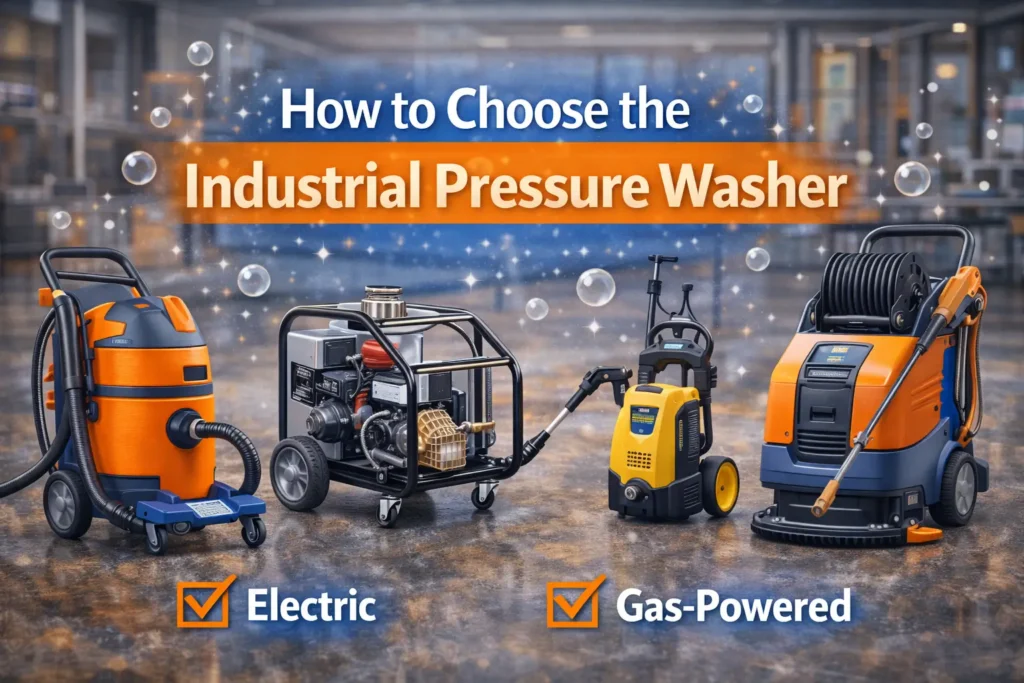
Choosing the right industrial pressure washer requires matching PSI, GPM, power source, and nozzle type to your specific cleaning application. Industrial models range from 2,000 to 5,000+ PSI and are used in manufacturing plants, construction sites, fleet washing, and food processing facilities. Selecting the wrong unit wastes money, damages surfaces, or leaves jobs incomplete.
Here is a quick answer:
To choose the right industrial pressure washer, consider the cleaning task, pressure level (PSI), water flow rate (GPM), and power source (electric, petrol, or diesel). Also evaluate durability, mobility, and compatibility with cleaning chemicals to ensure the machine can handle heavy-duty industrial cleaning efficiently and safely.
What Is an Industrial Pressure Washer?
An industrial pressure washer is a high-powered cleaning machine that uses a motorized pump to force water through a nozzle at pressures between 2,000 and 10,000 PSI. Unlike residential models (typically under 2,000 PSI), industrial units are engineered for continuous-duty operation running 8 or more hours per day without pump failure.
They handle concrete, heavy equipment, vehicles, tanks, and processing equipment. Industrial models come in electric, gasoline, diesel, and hydraulic-powered configurations, with cold-water and hot-water variants for different soil types.
What You Need Before You Start
Before selecting a pressure washer, gather this information:
- Surface type: concrete, metal, painted surfaces, food-contact equipment
- Contamination type: grease, oil, mud, mold, chemical residue
- Job frequency: daily, weekly, or occasional use
- Location: indoor facility, outdoor yard, or remote job site
- Water supply: available GPM from your source (a 4 GPM washer needs 4+ GPM input)
- Budget: purchase price plus fuel/electricity and maintenance costs per year
- Compliance needs: food-grade facilities require NSF-compliant detergents and stainless components
Industrial Pressure Washer: The Complete Process
Step 1 – Determine the Required PSI
PSI measures the force of the water stream. Exceeding the recommended PSI for a surface causes permanent damage.
- Use 2,000–3,000 PSI for vehicles, painted surfaces, and wood
- Use 3,000–4,000 PSI for concrete, machinery, and fleet washing
- Use 4,000–10,000 PSI for industrial tanks, heavy equipment, and surface prep before coating
Step 2 – Calculate the Required GPM
GPM determines how much water is delivered per minute. A 4 GPM unit at 3,000 PSI (Cleaning Units = 12,000) cleans faster than a 2 GPM unit at 3,000 PSI (6,000 CU). For large surfaces warehouse floors or semi-truck fleets target 4–8 GPM. For detailed work or confined spaces, 2–3 GPM is enough.
Step 3 – Choose the Right Power Source
Electric units run on 120V or 240V and produce zero emissions ideal for enclosed facilities and food plants. Gas-powered units (Honda GX series is industry standard) deliver higher PSI anywhere without electrical access. Diesel units suit construction and mining sites needing maximum runtime. Hydraulic-powered washers mount to skid-steers for remote heavy-duty work.
Step 4 – Decide Between Cold Water and Hot Water
Cold-water washers remove dirt, mud, and loose debris well. Hot-water washers dissolve grease, oil, and biological contamination up to 60% faster than cold water at the same PSI. Food processing plants, auto repair shops, and dairy farms require hot-water models. Hot-water units cost 30–50% more but reduce chemical use and total cleaning time.
Step 5 – Evaluate Pump Quality and Duty Cycle
The pump is the most critical component. Brass-manifold pumps (Annovi Reverberi, General Pump, Cat Pumps) outlast aluminum pumps by 3–5x and are field-serviceable. Verify the duty cycle: commercial-grade units run 4–6 hours daily; true industrial units sustain 8+ hours. Triplex plunger pumps are more durable than axial cam pumps for high-frequency use.
Step 6 – Select Compatible Nozzles
Nozzles control spray angle and water concentration. The five standard angles: 0° (red, maximum force), 15° (yellow, stripping heavy grime), 25° (green, general cleaning), 40° (white, delicate surfaces), 65° (black, low-pressure soap). Rotary/turbo nozzles spin the stream in a circle and increase cleaning speed by up to 40%. Match hose diameter (3/8″ for 4+ GPM) to your unit’s flow rating.
Step 7 – Assess Portability and Frame Design
Skid-mount units bolt to truck beds or trailers for mobile operations. Cart-mounted units roll around facilities. Wall-mount units save floor space in fixed wash bays. For remote sites, trailer-mounted units with onboard water tanks (50–200 gallon) eliminate dependence on an external water supply. Stainless steel frames resist corrosion; powder-coated steel works for dry storage.
At Kemtech Hygiene Concepts we are trusted suppliers of industrial pressure washers in UAE offering a wide range of high-performance units matched to every cleaning application. Explore their full lineup to find the right industrial pressure washer for your facility’s exact PSI, GPM, and duty cycle requirements.
Industrial Pressure Washer Selection at a Glance
| Application | Recommended PSI | Power Source | Water Type |
| Fleet / vehicle washing | 2,000–3,000 | Electric or Gas | Cold or Hot |
| Concrete / warehouse floors | 3,000–4,000 | Gas or Diesel | Cold |
| Grease / oil removal | 2,500–4,000 | Electric (indoor) | Hot Water |
| Food processing equipment | 1,500–3,000 | Electric | Hot Water |
| Heavy equipment / mining | 4,000–10,000 | Diesel or Hydraulic | Cold or Hot |
| Surface prep / coating work | 3,500–5,000 | Gas or Diesel | Cold |
How Long Does Selecting an Industrial Pressure Washer Take?
A thorough selection process takes 1–3 business days. Gathering site requirements takes 2–4 hours. Comparing specs from vendors like Mi-T-M, Karcher, Hotsy, Landa, and Simpson takes another 2–4 hours. Getting quotes from 3 suppliers adds 1–2 days. Rushing leads to wrong equipment purchases that cost more long-term.
How Often Should You Re-Evaluate Your Pressure Washer Needs?
Re-evaluate every 2–3 years or when operations change significantly. If your facility adds new surface types, increases cleaning frequency, or expands to outdoor locations, your original unit may no longer be adequate. Also reassess after pump replacement some facilities upgrade rather than rebuild.
Pro Tips for Best Results
- Calculate Cleaning Units (PSI × GPM) to compare models objectively higher CU means faster cleaning.
- Use a downstream chemical injector to apply detergent through the system without a separate pump.
- Choose belt-drive pump configuration for high-frequency work; it runs cooler and lasts longer than direct-drive.
- Verify parts availability before buying Cat Pumps and General Pump have nationwide service networks.
- Install an inline water filter to protect the pump from particulate damage.
- For multi-operator facilities, consider a central pressure washer system with multiple hose reels.
Frequently Asked Questions
What is the fastest way to choose an industrial pressure washer?
Calculate your required Cleaning Units (PSI × GPM) based on surface type and contamination level, then filter models by power source and duty cycle. Narrowing to three vendors and requesting a demo takes 1–2 days and prevents costly mismatches.
Can I complete all industrial cleaning jobs with one pressure washer?
Most facilities handle all tasks with a single unit by swapping nozzle angles (0° to 40°) for different surfaces. Hot-water units with a downstream chemical injector cover the widest range of soils without needing a second machine.
What are the best industrial pressure washer brands?
The top brands are Karcher, Hotsy, Landa, Mi-T-M, and Simpson. Karcher and Hotsy lead in hot-water units; Mi-T-M and Simpson offer strong cold-water options with wide parts availability. Cat Pumps and Annovi Reverberi produce the highest-rated replacement pumps.
What is the most common challenge when selecting an industrial pressure washer?
Most buyers underestimate the required GPM. They focus on PSI and buy a high-PSI but low-GPM unit, resulting in slow cleaning. Always calculate Cleaning Units (PSI × GPM) and prioritize flow rate for large-area jobs.
What should I do first when buying an industrial pressure washer?
Document your cleaning requirements: first surface type, contamination category, daily hours of use, and power source availability. This eliminates 80% of unsuitable models before you even contact a supplier.